Showing posts with label Military. Show all posts

Sunday, September 11, 2011

Three Months in Afghanistan

Today's post comes from a response that I recently sent to a couple of my Soldiers who participated in some of the operations referenced below.  They requested a brief account of our last few months in Afghanistan and, after finalizing the editing process, I felt the summary would also make a suitable basis for a posting on the tenth anniversary of the attack that caused us to deploy there in the first place.  

As other peers and colleagues post remembrances and tributes today, I don't feel like mine is particularly special or unique; but, I do believe it offers a little something extra to their contributions and other outlets you may have already perused.  To my new Moroccan friends and current colleagues, I share this brief account as a different perspective from those that you may be familiar as well as to continue to introduce myself.  And, to SSG Vile, SGT Pirtle and SPC King, I hope it contributes to their remembrance in some small way.

In general, this is a brief operational overview of my old troop, C/6-4 CAV – a dismounted reconnaissance unit deployed to Konar Province, Afghanistan, between June 2008 to June 2009 – during the final two months of our deployment in support of Operation Enduring Freedom IX. The daily specifics of the troop’s mission varied during this period but primarily focused on securing the area against the “Anti-Afghanistan Forces” (AAF) that operated in and around the town of Nishigam, Ghaziabad district.

To accomplish this security mission, the troop established a company-level combat outpost (COP), conducted mounted and dismounted combat patrols, and supported the Afghan Army observation post (OP) that overlooked Nishigam and two valleys that converged there. On May 1st, a large AAF force overran the small OP, and we subsequently altered our operations.  After the ensuing brigade-level operation to stabilize the area and secure Afghan prisoners of war concluded, the troop shifted manpower and resources to rebuild and secure the OP until its redeployment a month later.

Members of Blue Platoon patrolling in the mountains north or Nishigam.  The terrain was pure mountains, with one range north of the Kunar River and another south of it.  Three main valleys converged into the river and acted as active routes for AAF.

At the time, C/6-4 CAV consisted of two maneuver platoons (White and Blue) and a headquarters platoon (our third maneuver platoon, Red, was split from us and operating to our north).  Prior to the shift towards a more static footprint on May 1st, each of the maneuver platoons conducted at least seven multi-day security operations that typically lasted between 72 and 120 hours.  

While "outside of the wire," the platoons typically set up ambushes, conducted search operations, engaged locals, checked on contracting projects, defended the local government center or trained Afghan security forces in an attempt to improve each of the factors leading to a more stable region.  During these patrols, each platoon was typically engaged by ineffective long-range AAF direct or indirect fire that typically left all involved uninjured and any equipment without a scratch.

Soldiers set up an indirect fire system during an occupation mission.  Though mostly uninhabited, more than 30,000 people still called the region home.  Unfortunately, most of them lived in small villages away from the central river, limiting our interaction as well as our ability to directly support them with projects and community services.

On May 1st, about a week after we began establishing our COP in a key location along the only road in the region, a four-day fight broke out when approximately 100 AAF fighters surrounded and overran OP Bari Alai, the Afghan Army OP overlooking Nishigam.   During the raid, AAF killed three American and a handful of Latvian and Afghan Soldiers and captured another 11 Afghan Soldiers. At the time of the attack, White platoon was conducting security operations at the new COP, leaving Blue platoon to respond and maneuver by vehicle and foot to the village while a quick reaction force led by our squadron commander moved by helicopter to the site.

For the next 18 hours, members from the troop headquarters and Blue platoon - augmented by another unit - pursued AAF fighters while White platoon secured the COP and its supporting OP.  After the maneuver, White and Blue platoon switched responsibilities, with White platoon moving to OP Bari Alai, where it rebuilt and defended the small outpost for the next month and a half.  

Blue platoon moved to the COP and assumed primary responsibility for its security.  But their reprieve from fighting was brief and on May 3rd, a force estimated at fifty AAF fighters attempted to raid the their OP in a similar manner to OP Bari Alai.  Defeated after an hour of hand grenades, direct fire, mortar and artillery, the enemy retreated but spent the next few days unsuccessfully attempting to retrieve their dead and wounded in what became the last significant fight of our deployment. 

Some of the members of Blue Platoon after more than three days of pursuing AAF down the mountain and defending the COP OP in "less-than-ideal" conditions.

After this action, both platoons primarily conducted static security operations at their respective positions, Blue at the COP and White at the OP. During the final month, each platoon came under sporadic AAF direct and indirect fire attacks while attempting to establish, fortify and secure their positions.

In total, the three-month period between April and June marked an active time for C/6-4 CAV. The troop conducted over 20 security operations, excluding the COP establishment COP and the OP rebuilding and engaged in direct or indirect fire with AAF more than thirty times in its attempt to secure and stabilize the area. During the conflict, each side sustained losses.

Fortunately, outside of the AAF raid on Bari Alai, the human toll to Coalition Forces (CF) only involved one minor wound sustained during an RPG attack; however, losses in equipment and confidence of the local population had a much more dramatic effect on unit morale and mission effectiveness. Effects on the AAF were also mixed.

Though we estimated over a hundred AAF were taken out of the fight during this period, the success of their attack on OP Bari Alai as well as their ability to continue harassing attacks after the brigade operation displayed to the Ghaziabad population that they had the potential ability to outlast CF initiatives within the region. This result most likely offset any lasting positive effects of the AAF's diminished numbers.  Further, I have a feeling that new recruits replaced old fighters, and the population was less likely to believe in or support our security mission.  But, these weren't "deal-breakers," only negative factors to work through.

White platoon testing one of the first TOW-enabled MRAPs in the region.

Through it all, our security operations varied but were continuous.  Between the months of April and June, the troop worked hard, escalating the tempo of operations while most other units either sustained or drew theirs down.    Each member of the troop engaged in AAF direct or indirect fire engagements that either concluded after a couple of shots or, in one instance, a few days. Despite these engagements, the unit improved the district’s infrastructure and communal governing body while preparing for a change of authority with the incoming unit and subsequent redeployment.  

I've never been more proud to be a part of a group of men.  For all their hard work, courage and sacrifice, I offer my thanks today and everyday.  Keep up the good work; America wouldn't be here without it.

This post was written from the viewpoint of the troop commander and reflect his perspective two years after C/6-4 CAV redeployed. I produced my facts and statistics from saved records and reports that were written during or near the time of the deployment. If you have any questions, comments, additions or clarifications, please direct them to jay.bessey@gmail.com.  To my former Soldiers, I'd love to hear your perspective, so please send it!

Monday, July 25, 2011

Half a Year in Arab Time

Throughout my 3 1/2 years spent in Islamic countries, one expression has entered my ears more than any other except "Enshallah" (God willing).  This oft-used phrase is "Arab time."  Embraced by many of my Arab counterparts, I typically welcome it with a grain of salt, as it implies that minutes, hours, days, etc last just a little longer on an Arab watch than on my Timex.

When I hear the mention of this "phenomenon," I know to expect my Arab counterparts will be late for our meeting or take a little longer to get something done.  Three "western days" equate to five "Arab days," my tanned buddies have been eager to inform me.  It's a little frustrating at times, but those frustrations haven't shown up too often during this, my most recent foray overseas.

So, in the spirit of "Arab Time" (and admittedly writing this report a little late), I won't hesitate to claim this report covers my first six months rather than the seven it truly represents.  It's time again for a little reflection, as I've done at the 1-week, 1-month and 3-month marks of my time in Morocco.  Today, I'll take a look at some of the goals that I've set for my time here and how I think I'm doing at obtaining them.  I classify each as mid-range goals, as I have about two years to accomplish them, and this is the last you'll hear of them until the one-year mark...western time (Enshallah).

Broadly derived from the Olmsted Foundation's mission statement, my goals are to (1) achieve fluency in Arabic, (2) obtain a graduate degree from Al Akhawayn University, (3) understand Moroccan cultures, and (4) return to the Army better equipped to serve as an Infantry Field Grade Officer.  So, today I ask, "Am I off to a good beginning?"  Using a scale from 1 to 10 (1 being the worst), I'll use a loose "issue, discussion, recommendation" format that hopefully provides a reference point to current and future scholars as well as some general information for those of you who are just plain interested or curious.

1.  Achieve Fluency in Arabic - 5 / 10.  This is my lowest score, and I don't know if I'm being hard on myself, the deck's slightly stacked against me or I'm just not working hard enough - probably a little of each.  Regardless, this is the "big one," and I think I need to do three things to complete it: (1) Carry on conversations in Arabic with locals about most non-technical subjects, (2) Watch or listen to Arabic news and standard programming while understanding about 75% of the details, and (3) Read and write in Arabic at a high-school level.

Feeling confident about Goal #1's start has been difficult.  Regarding the first sub-point, it's been rough-going to practice a true "give-and-take" conversation exclusively in Modern Standard Arabic (MSA).  Though a few reasons exist, the most prescient is that some Moroccans actually scoff at speaking in anything other than French or dialect.  Not able to understand either, this has made it difficult to engage in meaningful conversations with the majority of the population.  A few of my friends make a good effort to communicate only in MSA, but unfortunately their efforts are few and far between.  Fortunately, I anticipate this situation will significantly improve when I begin classes in September.

I feel more confident in my ability to do the second and third sub-tasks due to a couple factors.  Not involving "speaking," they are more individual in nature and involve skills in which I have excelled since beginning my studies almost two years ago.  First, regarding listening, I have plenty of opportunities to hear MSA and attempt to understand high-level subjects, as there is no shortage of Arab news channels and programming finding their way through my satellite receivers.  Though some of them are broadcast in Egyptian, Iraqi and Syrian dialect, the majority are exclusively in MSA.  These channels have been free as well since my landlords have "included" satellite payment in the rent.  Another asset has been the radio; typically used only during long road trips, Moroccan radio is about 50/50 MSA and typically covers relevant regional and national news.

The last part - reading and writing - has been an individual endeavor where I've relyed on weekly circulars and old DLI textbooks to continue improving my skills (yes, nunchuck skills).  With the various dictionaries and Google translate assisting this effort, it was my strength in California and remains the strongest of the three sub-tasks thus far in Ifrane.  Further, the periodicals are cheap (usually costing $1.50) and assist my familiarization with the Moroccan government and its current political climate.

Recommendations / "Improves:" Speak daily with locals and convince them to speak in MSA.  I've not done this enough, and my conversations have continued to revolve around a few familiar topics.  Find a one-on-one tutor and meet with him or her weekly, focusing on verbal communication.  Again, I've not done this and probably could've benefited from it.

2.  Obtain a Graduate Degree from Al Akhawayn University - 8 / 10.  Though I haven't started my first class yet, I've completed all admissions requirements and only await orientation to begin in a few weeks.  Until then, a few extracurriculars have helped while a few have been missed but could have been pursued.  First, I've kept in contact with my primary adviser throughout the past year and a half.  Though this contact has been limited, I believe that it's kept me on course with admissions requirements and reading recommendations that will assist me once I begin my classes.

These recommendations lead me to my one acknowledged negative, as I've not been able to access them yet.  Therefore, his advice remains only another task on the "to-do" list.  Back on a positive note, the Office of International Outreach has been invaluable in providing student information through Facebook, covering everything from arrival coordination to first-year recommendations.

Recommendations / Improves: Maintain an active dialogue with three university sections: Admissions, International Outreach (if available) and your future department.  Arrive at your host country with a good computer able to access professional and academic resources.  Having purchased a computer abroad, I've had to jump through digital hoops to set the thing up and still need to download / upload more software before class begins.  It's been a small headache, but an avoidable one nonetheless.

3.  Understand Morocco's Cultures - 9 / 10.  Though I don't want to imply that I "know" Morocco's cultures and am able to differentiate between the various Berber, Arab and French influences, I think I'm onto a good beginning and one that I wouldn't be able to begin during the school year.  The main reason why I think this is because the only way to do it is to travel around the country and see it yourself.  This, I've done to a good degree.  As a result of this thinking, I've prioritized travel over structured language training and physical fitness (in most cases).  Knowing the country's features and how to navigate through them is a large part of understanding the people who live in them.

One may be able to read about Arab hospitality, but it is entirely different experience when you're at the receiving end of a flat-bed truck ferry over a flooded causeway.  Further, reading about festivals and celebrations doesn't include the actual sound of the music, smell of the food or feeling of a muggy sunset on your skin.  Thankfully, I've had time prior to my studies to form a foundation of experiences to build upon.  I have a long way to go before I'll feel comfortable describing the differences between the plethora of cultures in this country, but that should be easier to do with concrete memories!

Recommendation / Improve: Travel as much as possible and see the things that you may not get the chance to explore while working on an advanced degree!  Tons of resources like the Lonely Planet series and "Trip Adviser" are easily accessible and quite helpful.  However, treat them as a guide and not ground truth (as they tend to lose relevancy and may be written through biased eyes).

4.  Return to the Army better equipped to serve as an Infantry Field Grade Officer - 6 / 10.  I've found that this goal requires the most individual determination and has been the most difficult to devote time to toward the beginning of my tenure.  Fortunately, I also believe that some of the sub-tasks required can be put off at the beginning of this experience.  This goal consists of three sub-tasks: (1) Understand how to relate the experience to my next (and future) jobs, (2) Prepare for my future job technically and physically, and (3) Keep in touch with the Infantry community.

Regarding the first task, it's not too early to start thinking generally about how my Moroccan experience can positively influence my future duty assignment; however, with two years remaining, it's still a little early to start consolidating and making sense of individual experiences - I still need to understand the governmental and cultural aspects of my host country far better than I do now.

I've started to continue chipping away at the second task, incorporating the "Military Monday" segment of this blog.  This has already paid some dividends, as I've forced myself to crack old field manuals and look through operational and logistical presentations and documents.  Regarding the physical component, participating in organized races has been helpful, but I've not placed a high premium of staying in "elite" shape due to conflicting travel itineraries cutting into a good routine.  This is one of those aspects where I believe there is still time to get in better shape before returning to the land of "Follow Me!"

The last part of the fourth goal calls for keeping in touch with the Infantry community, which has been one of the more enjoyable "tasks" thus far, as it involves emailing / calling / meeting with old friends and mentors as well as setting up future training and assignment opportunities with my branch.  I've never regretted choosing Infantry as my branch some nine years ago, and maintaining a close bound with it only comes naturally.

Recommendations / Improves: Keep a journal or blog to keep up on experiences; as for me, I forget too much unless I write it down.  The blog has been the one lasting technique that I've ever used to somewhat accomplish this overlooked part of development.  Once a week, get back to your roots and start preparing for the next job.  No one should begin the preparation process on the first day - there just isn't time to do it!

Sunday, May 1, 2011

In Memory: Three Good Men

The first of May was a difficult day for American forces deployed to the Ghaziabad district of Afghanistan back in 2009.  That day, anti-Afghanistan forces massed on a small outpost overlooking the village of Nishigam and forever took from us three tremendous American Soldiers in an early-morning attack.


The men, SSG William Vile, SGT James Pirtle and SPC Ryan King fought bravely and will forever be remembered by the men and women with whom they served so honorably.  Below are excerpts taken from the "Honor the Fallen" section from www.militarytimes.com.  I ask that you take a moment and join family, friends and those of us who were in Ghaziabad that day in the remembrance of our brothers in arms.  Rest in peace, men.


Army Staff Sgt. William D. Vile

Died May 01, 2009 serving during Operation Enduring Freedom 

27, of Philadelphia; assigned to the 1st Brigade, 1st Infantry Division, Fort Riley, Kan.; died of wounds suffered when insurgents attacked his unit using direct fire May 1 near the village of Nishagam, Konar province, Afghanistan. Also killed were Sgt. James D. Pirtle and Spc. Ryan C. King.


Staff Sgt. William D. Vile, 27, of Philadelphia, who was assigned to a military transition team in Afghanistan, died of wounds suffered in an attack May 1 when insurgents attacked his unit using direct fire and rocket-propelled grenades, officials said.The attack took place in the village of Nishagam, Konar province.


Vile was assigned to 1st Brigade, 1st Infantry Division, from Fort Riley, Kan.
Soldiers and service members from other branches of the military are trained at Fort Riley in a 60-day course to advise, teach, mentor and coach their counterparts in Iraq and Afghanistan.
(below, from The Associated Press)
On his first tour in Iraq, William D. Vile was a gunner on a Humvee that was struck and turned over by a roadside bomb.
He told his fiancée, Heather Jackson, “I popped right back up,” but the Army thought his wound deserved a Purple Heart.
Then during his first tour in Afghanistan, he was watching as a helicopter landed with troops. As soon as it landed, the surrounding hills “lit up with enemy fire,” he told her.
He ran to get his flak vest out of his tent and took a bullet in the arm. He pretty much fought off the medics trying to attend to him.
“I need something to stop the bleeding,” he told them. “I have work to do here.”
Vile, 27, of Philadelphia died May 1 when insurgents attacked his unit in Konar province, Afghanistan. He was assigned to Fort Riley, Kan., and was on his fourth tour of duty.
“I never met anybody who was so honest,” Jackson said. “He never put on a mask. He was never anyone but himself. Bill was larger than life.”
He enlisted in 1998 after graduating high school. He had two Purple Hearts for wounds in combat in both countries.
He also is survived by his mother, Donna.

(To View SSG Vile's full remembrance page, click here)


Army Spc. Ryan C. King

Died May 01, 2009 serving during Operation Enduring Freedom 
22, of Dallas, Ga.; assigned to the Special Troops Battalion, 3rd Brigade Combat Team, 1st Infantry Division, Fort Hood, Texas.

(below, from The Associated Press)
To Brittney Peters, it seems just like yesterday she and Ryan C. King and their friends were all hanging out and goofing off in the neighborhood.
“I bring myself to tears when I think of all the fun memories we had. I wish there could have been one last goodbye, there are so many things I would have said. Thank you for the memories that will make all of us remember you,” she wrote on an online bulletin board. “I never got the chance to tell you, I am so proud of you and what you have done.”
King, 22, of Dallas, Ga., died May 1 when insurgents attacked his unit in Konar province, Afghanistan. He was a 2005 high school graduate and was assigned to Fort Hood, Texas.
A few months after graduation, he enlisted in the Army, something he had wanted to do since he was a child. He went to basic training at Fort Sill, Okla. After he completed his training, he was stationed in Korea for a year, where he met his wife, Sgt. Rachel King.
At a memorial, Spc. Gregory Landgraf read stories of King publishing a newspaper lampooning the soldiers in his unit and a time when King tied his arm behind his back and took on a sergeant during a combative match.
(To view SPC King's full remembrance page, click here)

Army Sgt. James D. Pirtle

Died May 01, 2009 serving during Operation Enduring Freedom 

21, of Colorado Springs, Colo.; assigned to the Special Troops Battalion, 3rd Brigade Combat Team, 1st Infantry Division, Fort Hood, Texas.

(below, from The Associated Press)
James D. Pirtle graduated from high school in 2006 and immediately enlisted in the Army, despite his mother’s fears.
“Coming from a military family, I was very proud of him, but my first response was, ‘Why can’t you wait until it’s peace time?’ ” Patricia Pirtle said.
She said he was very patriotic and an enthusiastic soldier who quickly worked his way up to sergeant. In Afghanistan, he often volunteered for missions that he knew would be dangerous.
Pirtle, 21, of Colorado Springs, Colo., died May 1 when insurgents attacked his unit in Konar province. He was assigned to Fort Hood, Texas.
He was known to have a smile on his face, was a constant joker and was also the butt of many jokes. Once, teachers and students duct-taped him to a tree because he said it couldn’t be done.
“It took two full rolls,” said teacher Jan Songer. “We left him out there for a while.”
He also is survived by his father, James.
“He just wanted to be part of something bigger than himself,” said Andrew Thurn, one of his best friends. “He was OK dying if he was serving his country.”
(To view SGT Pirtle's full remembrance page, click here)

Tuesday, April 12, 2011

Best Ranger Competition

The sun's been down for about five hours and after walking most of it, I couldn't move another inch.  I had to stop.  "James, I need a minute," I said as I quit shuffling my feet, struggled to balance the weight on my back and stuck the barrel of my mock rifle into the pavement in front of my bent body.  Pain shot through each leg and up my back.  About an hour earlier, my rucksack pads quit cushioning the fifty-some pounds of weight from digging into my shoulders.  I adjusted my uniform over the tender sores they created and rested my head on the butt stock of my rifle, trying to create some additional relief for the small of my back.

This was probably the sixth such break in the past mile.  Through the passage of each of them, the big truck at the tail-end of the foot march drew closer, already carrying about a third of the competitors who couldn't finish the last event of the first day of the 2008 Best Ranger Competition: The Foot March.  The truck's large headlights and humming engine invited a couple more Rangers to hop on its backside.  With James' encouragement and a little gut, I picked my head up from the rifle and started moving my feet forward again, hoping to avoid the temptation.  A couple miles later, we were greeted by a different set of headlights accompanied by authoritative voices.  Relieved to hear the news that we'd just made it through the first day, we hopped on the back of their truck before they could change their minds and headed toward our next event.

At the end of this week, Fort Benning will host the 28th Annual David E. Grange, Jr. Best Ranger Competition.  Between 25 and 50 two-man teams will gather from around the Army's Ranger-tabbed communities to participate in a 60-hour competition that spans three days and typically over 50 miles of foot travel and 25 skill events.  Well-trained and professional cadre will challenge and grade the competitors at every turn in order to determine this year's best.

One of those competitors is a former colleague, Captain Glenn Burkey, and knowing what he'll be going through this upcoming weekend, I humbly ask that you give him and his partner some encouragement at gburkey@utnet.utoledo.edu or Facebook before Friday.  These two are currently serving as trainers, but I worked with Glenn in Texas, prepared for Afghanistan with him and later got to hear how well he'd done as one of the leaders at an outpost you may know, Restrepo.

Glenn (right) in the Korengal Valley, Afghanistan, with our Brigade Commander, Colonel Spiszer

Over the competition's three days, they'll be continually tested by physical, tactical and technical tasks that will challenge their strength, stamina, tactical savvy and technical proficiency, not to mention their teamwork, patience and "intestinal fortitude."  They'll need to balance each other in order to minimize mistakes, keep motivated and make it through each event.

The first day is a smoker intended to separate the physically-fit and determined from those who didn't train enough.  Competitors can expect to be constantly on the move between the morning's first event and the evening's final event, which has traditionally been the foot march that my teammate and I barely made it through three years ago.  Obstacle courses, marksmanship ranges, land navigation and a lot of running under large rucksacks will challenge each Ranger physically, forcing most men to balance all-out effort and conservation of energy throughout the day.  Smart teams will have trained for months to identify their breaking points in order to know how much they'll need to make it past this day.

 Hour 0...and the competition's beginning

 One of us landing on the drop zone.  It wasn't me.

Teamwork during the dismount of a wire ladder

With the conclusion of the physically-challenging first day, teams will most likely be technically-challenged with a multitude of skills events during the competition's middle 24 hours.  Typically ranging from individual tasks like weapons assembly to more obstacle courses, this round-robin affair is both a good break from the grueling pace of the first day and the final push of Day 3.  This day's stress comes from actually being able to do basic tasks and keeping calm under time pressures.  The evening's activity will challenge a team's ability to plan a route and move long distances at night.  After today, the top of the leader boards will reflect smart and competent Rangers, not just the most physically fit.

Getting ready to assess the situation in a trauma lane 

Performing first aid in the trauma lane 

 Hand Grenades, part of the skills competition

LT Bandi rappelling during the tri-tower event in 2008

After two nights of minimal sleep atop concrete slabs, Glenn and his teammate will enter the "home stretch" of the final six hours.  Emphasizing a mix of skills from the first two days, Day 3 challenges a team's ability to finish strong despite physical and mental exhaustion.  Typically consisting of a helo-cast, water confidence course and more running, competitors will want to stay "in the moment" and try to finish it as strongly as possible.  Teams that dwell on the hardships of the past may lose steam and miss an opportunity to climb the leader board.  Conversely, teams that look to the competition's finish may become complacent and find it difficult to keep motivated through each task.

 James jumping out during the helo-cast

 Hour 60...and the finish line

Each team, regardless of their final standing, should be proud to compete in this prestigious competition and hope to return to their units a little sharper, as they'll undoubtedly play a large role in preparing them for the next time that the rifles aren't fake and they won't be able to take a break in the middle of the road without consequences.


Thanks to my partner, James, as well as the leadership that sent us (and three other teams) to the competition three years ago for making the above picture possible.  Your impact is still being felt today, as Glenn seeks to have the same moment.  Good luck, Spader!

Special thanks to the Stultz's and the Duke PAO for the pictures

Friday, March 11, 2011

The Return of "Duty, Honor, Country"

I like my long hair.  For those of you whom I've attended school with, served with abroad or spent time with during any of my breaks, this shouldn't come as a surprise.  Given my branch, I've had a tendency to "blade run" more often than not regarding how I adhere to published hair standards.

So, when it came time to cut my ridiculously long hair for the first time in over a month, I knew that I was past-due but still not exactly itching to make it happen.

A little background as to why.  The past couple of months since my language course in California have been a figurative and literal departure from the previous 15 or so years of my life in many ways.  Living abroad away from anything military, not wearing a uniform or being responsible for anything but myself are all dramatic departures from my previous norms, where working as part of and leading teams came daily.

During this time, I've taken some liberties that I wouldn't / couldn't have taken before graduating from language training in Monterey, where adhering to the aforementioned standards was a daily requirement.  As someone who entered the Army in 1995 seeing himself departing it in 1999, I consider two months of relaxed standards a fair length of time.

So, I've loosely taken the relaxed grooming standards, ability to dress myself in something other than ACU-pattern and the lack of proximity to anything military as opportunities to take a few steps closer to fitting in to my host country.  So far, it appears to have worked.


I've wanted to maintain a relatively low profile regarding my military status and so far, I've not once been identified as a military sort.  In some cases, I've been met with disbelief when I later revealed my profession.  The reasons are various and may have included the occasional pack of cigarettes that I've been observed smoking, my long hair or the gutturally-satisfying "freedom beard" I tried to grow a month ago.

But the times, they are a changin', and with the recent reception of my household goods, I feel that my allotted time to escape certain responsibilities and freedoms that accompany the untethered has come to an end.  Instead of an open apartment with little ties to the outside world other than an internet connection and satellite dish, I find a filled, established living arrangement complete with printer, direct phone access to the States as well as a bevy of workout equipment that's been begging me to put it to use since being neglected in the hull of a cargo ship for the past month or so.


In the spirit of this change, long hair, smoking and eating all the tagine that my waistline can fit hardly seems appropriate anymore.  Smoking stopped weeks ago, eating better has come after the day I got beat up by my elevator, and now seems to be a good time to again represent the service that's taken care of me so well over the past decade and a half and I've come to owe so much with a suitable haircut.

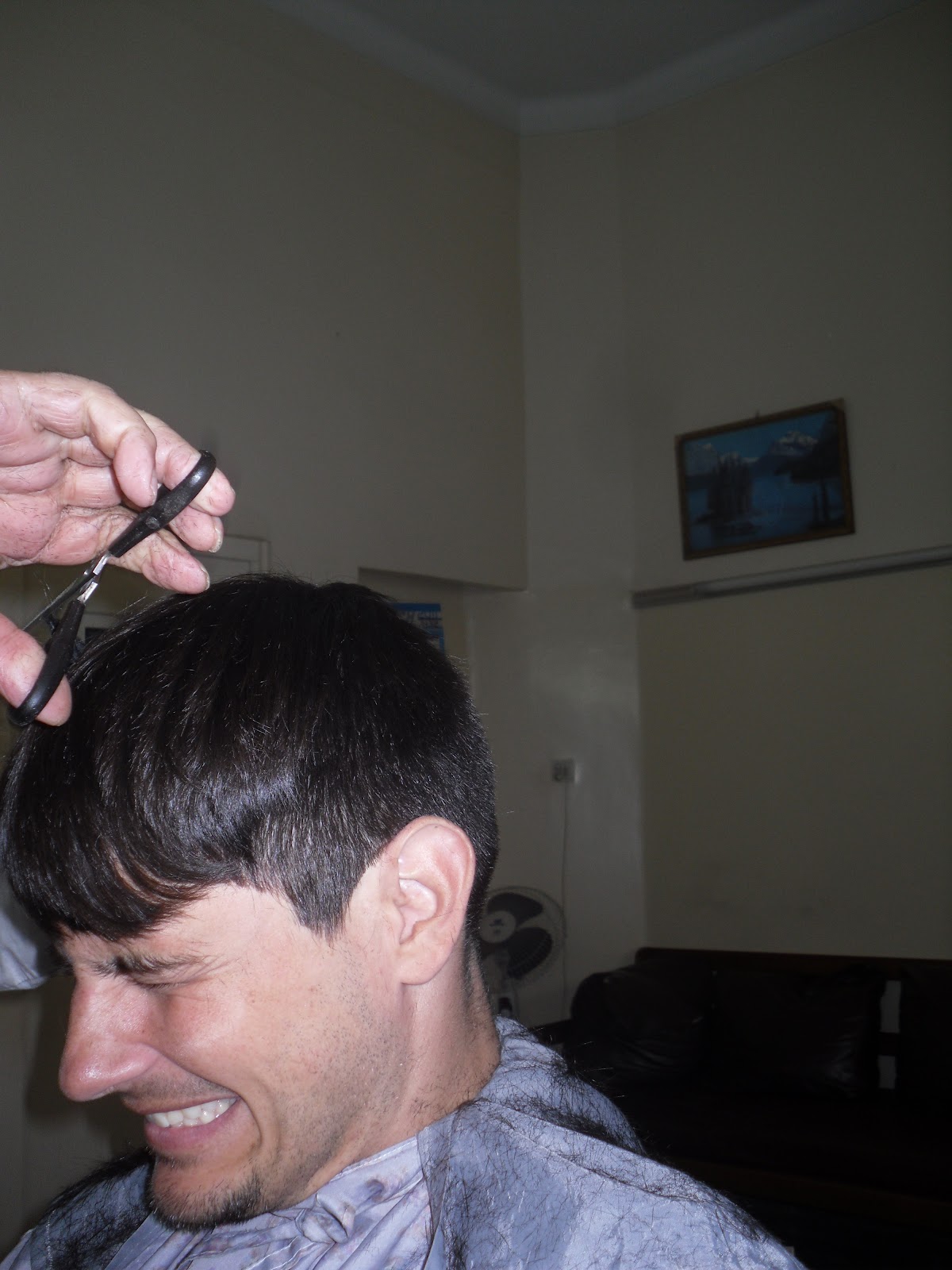
While reconnoitering the right barber spot with one of the embassy's shipping agents, I spotted an incognito place that I was told houses a hair sage named Omar who not only worked wonders with clippers but spoke some English.  A day later, I was in his chair, trying to test out my Arabic skills on the subject.  After a few minutes of maybe getting my point across with hand gestures, little English phrases and a previous picture that my girl said she liked, we were on our way.

I took it like a man.

"Ma Salama Shari." (Good bye, my hair!)


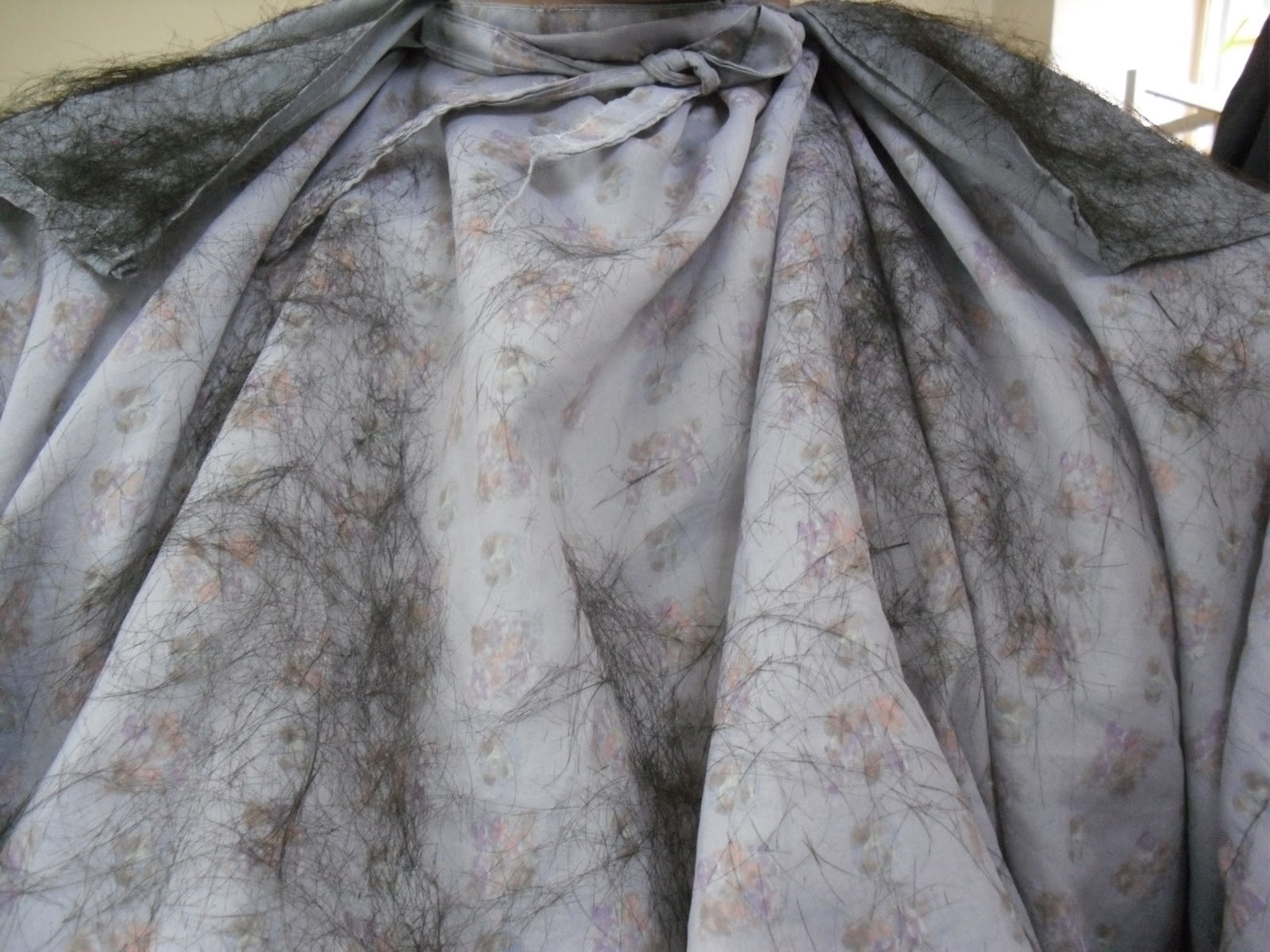
Hair covered my drape like freshly mowed grass....


...laid on the floor in tiny bails of hay...


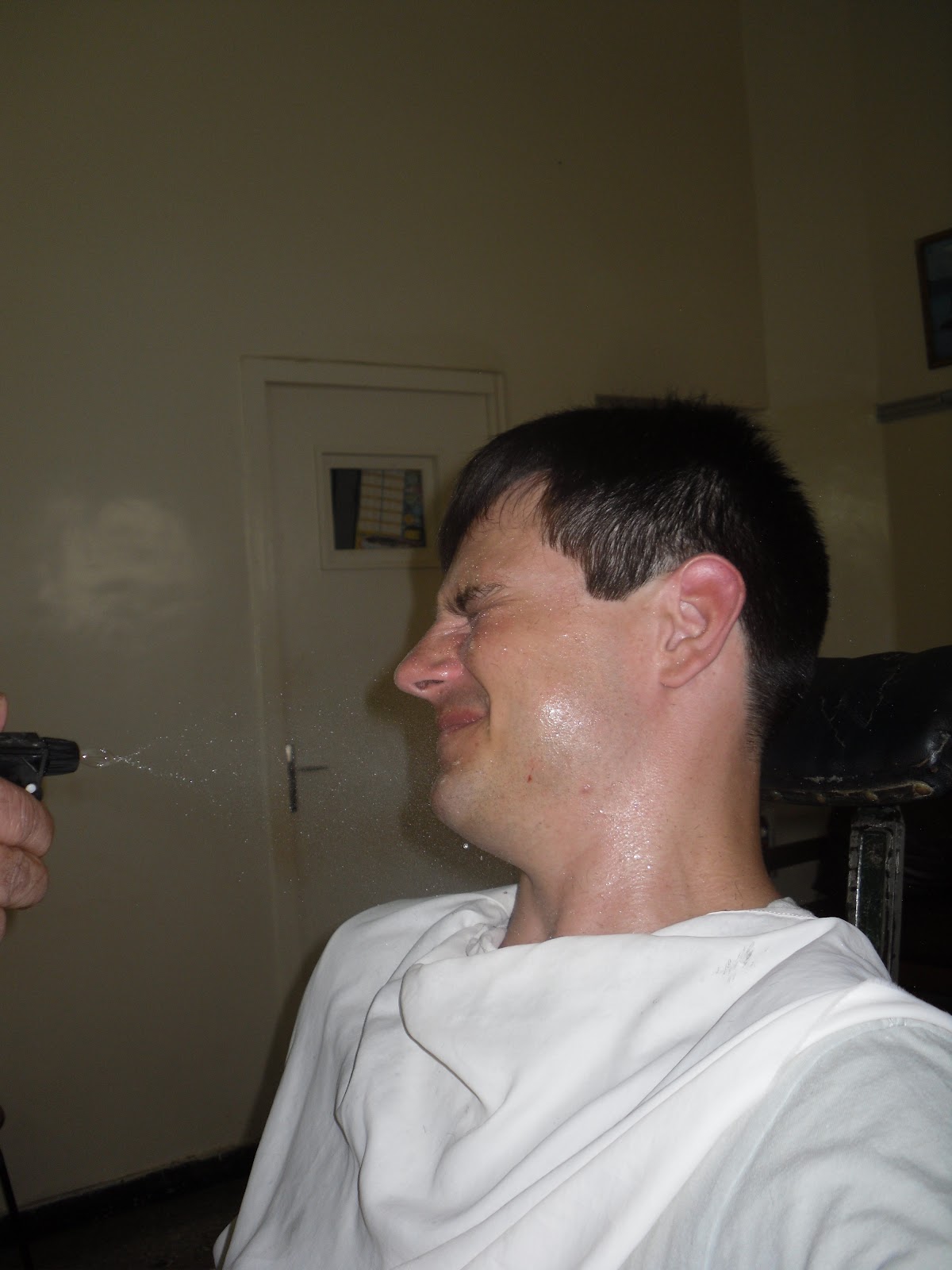
...and after my first barber-style straight razor shave ever, I got an enjoyable face-full of the heaviest alcohol spray in my life.  It may have been Everclear.


But when all was finished, I shook the father of eight's hand, happy with my decision to clean up, satisfied with the artisan's work, and ready to get back to physically representing the core values that place on the Hudson tried to instill in our class some eight or so years ago.


...until the next lapse hits me during my time abroad.

Saturday, March 5, 2011

On the Road Again... (Part 1 of 3)

I've seen glimpses of the big cities; now it's time to get on the open road and take in the eastern and southern attractions of my host country.  As per your requests, I'm off to the Sahara after spending an afternoon in Casablanca.  

This trip is a four-day guided tour from Fes to Merzouga and back to Marrakech.  The ultimate draw is Merzouga's reddish dunes, which are unique within Morocco.  To Fes - and from Marrakech - it's travel by train but everything in between is a mix of SUV and Dromedary (camel).  


Aside from seeing the sites and major attractions, my primary purpose is to see (and hopefully become familiar with) the majority of the population, as it still resides outside the big cities.  Further, I hope to take enough away from this trip to be able to guide my own tours as visitors (any of you) make it to Morocco for a trip...

Day One was long (10 hours by train and SUV) and from my pilot's seat, I had ample opportunity to take notes as my guide and I talked, we zoomed by villages and mingled with locals.  Below is a refined list of my notes for that day, edited as necessary...

Day 1: Rabat to Merzouga
  • Wake at 5:00 AM, Train at 6:07, Arrive Fes at 8:45.
  • Met with my guide, Zayed, at the Fes Station - young guy, been here since yesterday; there was a mix up regarding my arrival: they thought I was coming yesterday.  I feel bad.
  • Zayed, a Berber, teaches me a proverb of patience in how to deal with our 7-hour trek: نقطة بنقطة كيحمل الواد (Drop by drop, as the river is filled).  Slowly but surely, we will arrive.
  • There are four dialects of Berber.  Three are similar to one another while the final one differs dramatically.
  • In the Middle Atlas, we pass containers of all shapes, sizes, makes and colors on the side of the road, stacked on small piles of rocks.  They contain honey, which can go for 300 MAD (~$3.50) per liter.
  • The "moon rocks" north of Ifrane (my future home) remind me of the Goshta, Afghanistan, landscape.
  • The largest cedar forrest in the country sits in the Middle Atlas between the villages of Ifrane and Azrou.
  • The view of the Middle Atlas south of Ifrane is how I expected it (but didn't see during my last trip).  Beautiful but damn cold.
  • We pass by the most beautiful building I've seen so far north of Azrou.  I'm told it's a UAE-built orphanage.
  • We stop by the only location in the country where we might see the Barbary Apes.  They don't show. 
  • Around the town of Timahdite, you farm, run a shop, herd sheep, belong to the 1% who are government employed or the remaining 50% who are unemployed.
  • After asked, Zayed tells me Moroccans refer to police as "snakes," not "pigs" or "bacon."
  • Generations ago, an old volcano spit up a ton of black lava rocks around Timahdite.
  • Small wheat fields the size of American gardens litter an otherwise barren hillside between the Middle and High Atlas.
  • Dogs of the village Itzer crowd the roads, waiting for lunchers from nearby Zeida to discard their scraps while heading north.
  • Between the two Atlases, the terrain is generally flat, sprawling and barren.  Ugh, four more hours until our destination.
  • The village of Zeida, like the three previous villages, is a ghost town.  
  • God, Country, King.  Written in white-painted rocks on most mountains, remind locals to keep their priorities straight.
  • Passing a military outpost, Zayed tells me most of the Moroccan Army are in the east, along the mountains.  I'm reminded of the Syrian border fort me and the boys occupied in 2003.
  • To get into the Moroccan Army, I'm told a recruit needs "to pay for the privilege."  I'm later told that most Soldiers later regret it because being a Soldier is a thankless job.  
  • The village of Midelt, population 35,000, is known as "The Big Apple."  It's the country's apple capital.
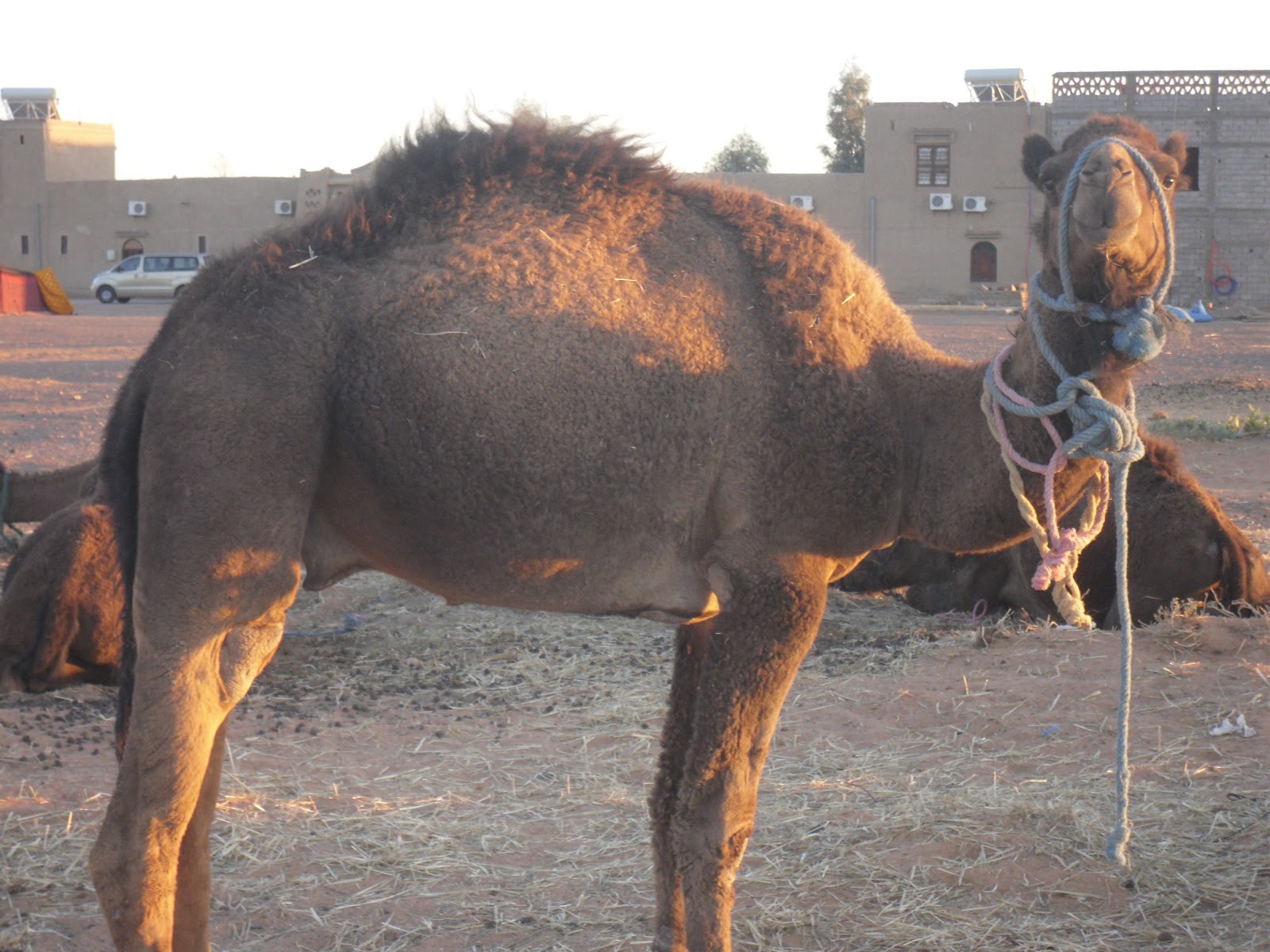
  • No camels in Morocco; they have two humps.  There are only Dromedaries with one hump.
  • Shakira reportedly filmed a perfume commercial in Merzouga.
  • Hillary Clinton also visited Merzouga because her family is from Morocco.  
  • Part of the movie "Legionnaire" was filmed in Merzouga.
"Legionnaire" Reviews (IMDb): Users: 4.9 stars / 10 stars (7,381 votes55 reviews | Critics: 22 reviews
  • Driving in the village of Kerrandou, around 70 protesters (mostly kids) walk in the other lane carrying banners and chanting about how the government needs to provide them more jobs and educational opportunities.
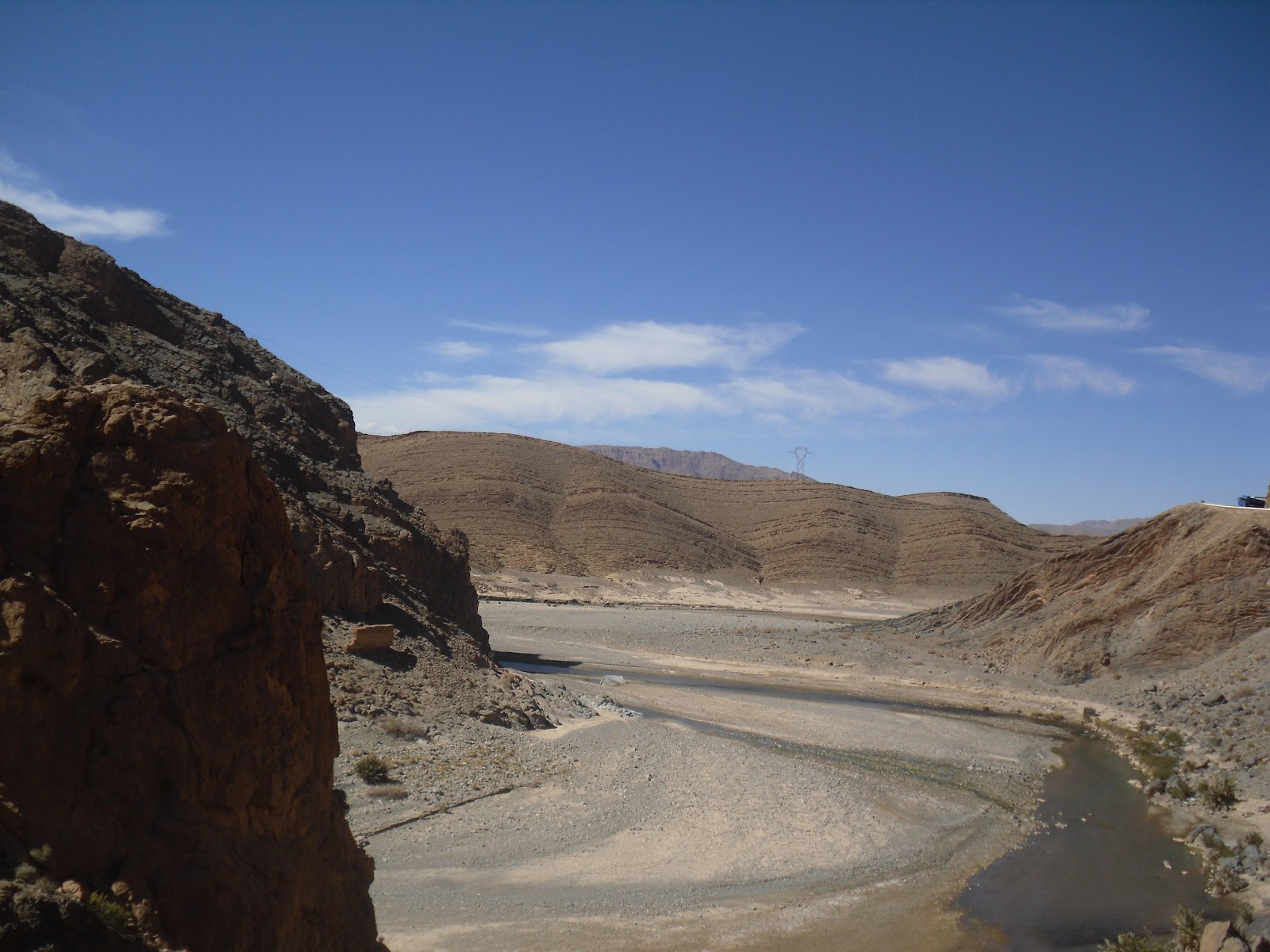
  • North of the Gorge du Ziz (big ravine of the Ziz valley), I'm told that in the summer it gets so hot (50 degrees Celsius) that the "humeer enfejroon" (the donkeys explode).
  • The Gorge reminds me of the Grand Canyon, except not as grand. This reminds me of my family; I look forward to seeing them again.

  • Another military post.  Two more hours until Merzouga (Thank God!).
  • Somewhere on our way to Timbuktu, I'm informed that there are 37 "States" in Morocco and 80 "Provinces."
  • The scenic overlook of the Ziz Valley is pretty impressive.  I learn what I feel I should've known already: dates come from palm trees.
  • The transical music that's been playing for the past two hours is from the Tuareg, a Berber tribe who moved from Morocco to Mali in te 1950's.  Speaking of Mali, the expression "Going to Timbuktu" comes from this area, as it took the caravans of old about 52 days to travel from south-central Morocco to Timbuktu, Mali.
  • We pass a Moroccan flag on a parked vehicle on the side of the road.  I'm told that means either someone's getting married or returning from the Hajj.  
  • The last village on our way to Merzouga is Erfoud.  Famous for dates and fossils, I couldn't care less because my butt hurts from seven hours of continual sitting.
Hard to see, but the writing on the ridge is an advertisement for all of the fossiles and minerals for sale in Erfoud
  • Another example of environmental issues: out the passenger-side window sits an area roughly the size of 8 football fields littered with all kinds of plastic (bags, bottles, etc.) from a nearby wind-scattered burning pit.
  • Shortly after the processed sea (and 45 kilometers west of Algeria), we finally spot the rosy dunes of Merzouga.
Tomorrow, I'll enter them.

Monday, February 7, 2011

The Super Bowl Abroad

I was a bad student today.  Or - more appropriately - I wasn't a student today, as I skipped class in favor of nursing a slight hangover after watching last night's game at the Embassy's American Club in the over-sized Marine Corps villa.  It was a late night spent drinking and mingling with some of the embassy staff, Peace Corps volunteers, visiting military members, and various ex-pats who included students studying abroad and English teachers in Rabat.

The atmosphere was light but engaging, as individuals and small groups of friends branched out to meet others while catching glimpses of the game on the large flat-screen between conversation, games of pool, burgers, cigarettes and other activities while the Embassy's Marines played host, bartender and staff.

Conversations typically started with the standard introduction and brief reasons for being abroad.  Each shed a little light on our official and unofficial presence in this multi-cultural country.  Aside from the close game, meeting some of my fellow ex-pats was the highlight of the evening.  A few of my favorite personalities...

Doug, the flamboyant embassy staffer whose carefree demeanor shed a little light on his wealth of experience abroad and unflappable outlook of our host country and how we do business here.  After a brief conversation with him, one might be less inclined to view living and working in a foreign country from the romantic perspective of a tourist.  Though we didn't discuss much work, talking to him was a good reminder that foreign service never ends and visitors should be just as aware of a country's political climate as much as its historical landmarks and tourist sites.

Jason, the young Civil Service worker who just arrived to the embassy a few days ago from D.C.  Optimism and a sense of duty were evident in him, and it was refreshing to see that type of outlook from a non-military type.  Eager to learn and get involved, he made the rounds and finished the night as one of the more popular guests after not knowing anyone some five hours prior.

Libby, an embassy staffer who didn't wait ten minutes before she got a commitment out of me to be on her softball team in the spring.  Hopefully, I fair better than my last stint in my old man's softball game (when I went 0 - 4 and tripped over my shoelaces in the outfield, letting in a couple undeserved runs!).

Mary and her friend, Rajaa; English teacher (and her friend) who's been in country for more than a couple years but doesn't speak either Arabic or the local dialect.

Cat, Mark, Gary and a couple other undergrad exchange students who paid out of pocket to study abroad here in Rabat.  Each live with Moroccan families, and the similarities appeared to end there, as I got a different answer from each of them regarding their universities, goals and attitudes.  Good kids in all, and I appreciated the conversation with one of them that described me as a typical product of "America's bastard military industrial complex."  We did, however, eventually agree that despite our different backgrounds we both wanted the same thing out of our experiences here!

The Fellows, Brittney and Gina.  Both having finished their graduate programs and conducting research in the area, these two were a couple of gems.  From Brittney's apparent mastery of Darija to Gina's recent experience in Egypt during the beginning of the "revolution," I was all ears and came away from our talks with another reason to want to improve my language skills and understanding of political science.

Aaron and the Peace Corps (PC) crew.  I didn't know that Morocco had so many PC volunteers, but according to them, it's one of the largest PC populations in the world.  Given the country's rather modest size and population (~ California and 33 million), I didn't expect that.  Hearing of their rugged lives in the Berber mountains and the Rif (North Morocco), I was reminded of Afghanistan and and how good I have it here.

The Marines.  Though small in number, these guys are big in personality!  Assigned to guard the embassy (as it's only a Marine job), these men threw a heck of a party.  Further, before last night, I thought they were just randomly selected out of basic training to fill vacancies at the post.  I was wrong; according to them, they needed to volunteer, pass tests, interviews and follow-on training prior to being selected. The attrition rate is high, and only the best are selected.  Each of them fit the bill and reinforced my admiration for the Corps!

After all was said and done, the Pack rolled, Rodgers got his trophies and I returned to the apartment around 4:30 am, knowing that I wouldn't see Gaelle and Gwyneth in class today.