Local Traffic.
Long trips over the Tizi n' Tichka pass and through the Dra'a and Sousa Valleys were the bread wrapping our desert sandwich. And these pieces were large, as it was four hours from Rabat to Marrakesh, four from there to Ouarzazate and another four to M'Hamid and the Erg Chigaga desert. And that was only one slice. The other slice - our return trip to Rabat - consisted of two legs and 14 more hours over to and from Agadir.
But despite these considerable distances, the sites and stops along these drives offered a wide variety of terrain and activities well worth navigating them. To Marrakesh and from Essaouira, crops were harvested on flat plains that extended from both sides of the highway. From Marrakesh to Agadir, the High and Anti Atlas sprouted over and cut under winding roads where driving even half of the posted 100 kph speed limit would've meant a one-way ticket off the side of a cliff.
Countryside between Essaouira and El-Jadida.
Combines Congesting Traffic.
Mom: "The upside [of the trip] came when we were on the final leg of the journey through the oasis filled stretches after our descent from the highest of the ranges. Filled with exotic palms, swaths of rich green bamboo, small grids of farm crops (obviously melons and other water demanding plantings) and native shrubs filled with pink, lavender and fuchsia blooms, the river supplied a diverse range of horticultural life - my reward for surviving my earlier torture!"
The Anti Atlas West of Agdz.
The Anti Atlas East of Agadir.
Mom: "The drive to [Ait Benhaddou] was more than I could handle without grasping my seat and re-directing my attention on the walls of rock that were opposite the weakly guard-railed drop-offs out the other window. Being an individual who sufffers from a fear of heights, (which unfortunately rubbed off on my backseat traveling companion, Megan) I found the ride through the high Atlas portion of the trip as a testimonial that I am not the most fun person to have in the car..."
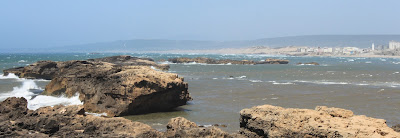
The Atlantic between Agadir and Essaouira.
The Atlantic between Agadir and Essaouira.
And between our three coastal towns, the other side of the Atlantic met mountainous fingers under clouded skies that broke with more rain than I've seen in my four months here and only cleared just enough for some wet and sloppy touring. The first stop along our tour was to the country's tourist hub, Marrakesh.
Across the Jamaa L'Fna, the Cafe sits shrouded by Tan Curtain and the Largest of the 20 or so Moroccan Flags draped around the Tourist Site.
I've covered Marrakesh a couple times before, and stops to the same places didn't offer much new, so if you want to explore them, visit the slideshow pictures or click
here and
here. One new site, unfortunately, did greet us: the remains of the late-April cafe bomb that killed 16 tourists and locals. Tastefully-covered, the site didn't do much to hinder the traffic around it, which was consistent most of the afternoon and multiplied tenfold in the evening. It looked like business as usual.
Ait Benhaddou, home of the kasbah most recently used in
Gladiator amongst many others, was next on the agenda and exposed a couple hard truths to my guests. First, the road between Marrakesh and Ait Benhaddou can be quite frightening (see mom's account above); second, food service in small towns leaves a lot to be desired and third, a muddy kasbah is tough to climb.
The Kasbah of Ait Benhaddou.
On the Way up in Ait Benhaddou. Numerous slick steps cut back and forth between art and gift shops, making an otherwise enjoyable trip potentially hazardous.
Atop the Kasbah, lunch would have to wait, as most of the restaurants below were closed or weren't serving most of the menus late in the afternoon.
A night in Ouarzazate greeted us after Ait Benhaddou's challenges, and we were helped to a different type of activity in the morning: a movie studio tour. Being Morocco's "Hollywood" (or "Mollywood"), Ouarzazate is home to a couple movie studios, some famous kasbahs and a movie museum. We visited two of them before heading to the desert later that day.
Part of Cleopatra's set at the Studio.
Megan on one of Cleopatra's props at the Movie Museum.
Backstage at the Studio Tour.
Part of Ben Hur's set.
One of the Props in Ouarzazate's Atlas Studios.
Indentured Servitude at the Movie Museum.
Grandma was picked as our Archer (our helper must've heard that she still hunts with a crossbow back in the States).
Sibling Rivalry...
...and Embarrassing Defeat.
After
the long, wet ride out of the desert, our trip to Agadir wasn't much better. Made more difficult by driving rain that flooded roads, rough road that was chewed up by mining trucks and jagged pieces of the Atlas that sat in the road, looking to pop exposed tires. After about two and a half hours, our biggest challenge yet awaited us.
We winded around the corner to find cars and trucks idling along the road's side, split by a seemingly insurmountable obstacle. Between them, a forty meter deluge of brown water flooded over the road's spillway into the valley rocks on the other side. The same image undoubtedly ran through each traveler's head: the torrent pushing his vehicle off the road into those rocks. Unfortunately for us, there was no way around the spillway; either we cross it or go back 150 minutes toward Agdz.
After most of the afternoon, no one yet braved the muddy waters until a small man slowly staggered across them, water up to his hips. Shortly after, the first vehicle - a large military truck - attempted the rift. With enough clearance between the road and his floorboards, he made it without issue, splashing my mom and I as he smiled off into the distance. His crossing sparked some ingenuity, and it wasn't much longer until financial opportunity entered a couple minds. Soon after, a flatbed wrecker started "ferrying" vehicles across the river and was kind enough to oblige us without much of a wait.
Part of the Spillway we would later cross atop Flatbed Wrecker. My Sister enjoyed this part of the trip as much as mother enjoyed driving through the Tizi n'Tichka.
The Sunset welcoming us to Agadir.
Safely on the "right" side of the river, we found safe passage to Agadir, finally arriving for a little bit of rest late in the evening. For the first time in a while, the sun welcomed us the next morning and brightened each of the city's three main attractions: the beach, port and mountain top overlook: the Effoulah.
Agadir's Crescent-Shaped Coast.
Baby Goats proved Irresistible.
Agadir's Port: A mix of Ship-building, Tourism and Shipping.
Agadir's Highest Point.
A few hours later, goats engaging in a peculiar pastime caused an unscheduled stop before our next destination, Essaouira.
Goats Climb Trees in Morocco.
The Biggest Goat-Covered Argon Tree.
The Goats crack the harder, outer shells of the Argon Fruit, exposing their oil-filled interior for harvest.
Essaouira's Famous for its Windy Coast.
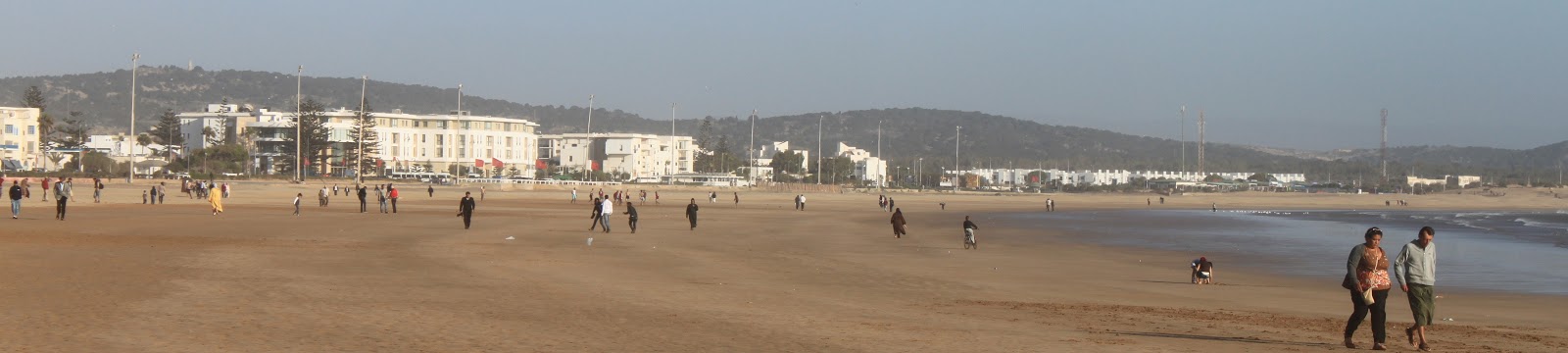
Smaller than Agadir's Crescent-shaped Coast, Essaouira's Beach was mostly filled by Moroccans and not Europeans.
A Wind Surfer between the coast and the Mogador Islands.
The further north we traveled, the better (smoother and straighter) the road seemed to get. Before we knew it, we were in El-Jadida and back on the national highway. A short time later, Casablanca passed on our left and Rabat welcomed us for a couple days of rest and laundry. Our southern trip was long and diverse but considered a good start the moment my apartment's front door closed behind the last of us.
"Hail of Bullets:"
- Gma says, "I was anxious to see the people and how they lived, their homes and how they made a living."
- Gma's Most Enjoyable Site: "I think I enjoyed the beauty of the landscape and flowers the most."
- Gma says, "What I didn't understand how going through towns little and big was how the men sat drinking whatever along the streets' cafe's just talking and looking, any time of the day."
- Gma's Interest: "What I found interesting were the flocks of sheep and goats tended by shepherds freely grazing. A small farm usually had rocks or cactus as fences."
- Gma says, "It seems to me the southern part of Morocco is not so far advanced in farm and building equipment as the northern areas."
"Planning Factor of the Day"
Renting a Car: Roughly the cost of a trans-Atlantic plane ticket, I considered this expense my contribution to the trip. Knowing that most of the trip would be away from the reliable train system, I looked at rentals. Though more expensive than public transportation, I figured this would cut out needing to find - and later waiting at - grand taxi stands and bus stations, as well as haggling with their operators.
Options were surprisingly varied, with numerous companies available to choose from in and around Rabat. I wanted a 7-person vehicle, preferably
with four-wheel drive. After a few days of searching, I found a company that promoted "no hidden costs" and upfront, all-inclusive payment as well as the option to pick up and drop off the vehicle at the Rabat Airport through Alamo.
After confirming both the reservation and time for pickup, I arrived at the airport only to find that Alamo didn't operate there and all of the rental desks were consipicuously unmanned. A phone call to my British-based rental agency confirmed that the reservation was from a different agency that had an empty counter at the airport.
Upon locating a couple phone numbers taped to the desk and talking to a few employees, I was informed that my vehicle would arrive in about 30 minutes - a good 30 minutes after the scheduled arrival of my family, who were unboarding their flight at the moment. Great start, I thought.
However, this would prove the only hickup with the van. The vehicle was bigger than I expected and would subsequently fit all bags and travel gear without issue. It made it over and through all mountain ranges and down all tight urban lanes. Being a diesel also halved planned fuel expenses, as we cut away from train stations and typical travel hubs to explore countryside only reached by bus or grand taxi.