Showing posts with label Afghanistan. Show all posts

Sunday, September 11, 2011

Three Months in Afghanistan

Today's post comes from a response that I recently sent to a couple of my Soldiers who participated in some of the operations referenced below.  They requested a brief account of our last few months in Afghanistan and, after finalizing the editing process, I felt the summary would also make a suitable basis for a posting on the tenth anniversary of the attack that caused us to deploy there in the first place.  

As other peers and colleagues post remembrances and tributes today, I don't feel like mine is particularly special or unique; but, I do believe it offers a little something extra to their contributions and other outlets you may have already perused.  To my new Moroccan friends and current colleagues, I share this brief account as a different perspective from those that you may be familiar as well as to continue to introduce myself.  And, to SSG Vile, SGT Pirtle and SPC King, I hope it contributes to their remembrance in some small way.

In general, this is a brief operational overview of my old troop, C/6-4 CAV – a dismounted reconnaissance unit deployed to Konar Province, Afghanistan, between June 2008 to June 2009 – during the final two months of our deployment in support of Operation Enduring Freedom IX. The daily specifics of the troop’s mission varied during this period but primarily focused on securing the area against the “Anti-Afghanistan Forces” (AAF) that operated in and around the town of Nishigam, Ghaziabad district.

To accomplish this security mission, the troop established a company-level combat outpost (COP), conducted mounted and dismounted combat patrols, and supported the Afghan Army observation post (OP) that overlooked Nishigam and two valleys that converged there. On May 1st, a large AAF force overran the small OP, and we subsequently altered our operations.  After the ensuing brigade-level operation to stabilize the area and secure Afghan prisoners of war concluded, the troop shifted manpower and resources to rebuild and secure the OP until its redeployment a month later.

Members of Blue Platoon patrolling in the mountains north or Nishigam.  The terrain was pure mountains, with one range north of the Kunar River and another south of it.  Three main valleys converged into the river and acted as active routes for AAF.

At the time, C/6-4 CAV consisted of two maneuver platoons (White and Blue) and a headquarters platoon (our third maneuver platoon, Red, was split from us and operating to our north).  Prior to the shift towards a more static footprint on May 1st, each of the maneuver platoons conducted at least seven multi-day security operations that typically lasted between 72 and 120 hours.  

While "outside of the wire," the platoons typically set up ambushes, conducted search operations, engaged locals, checked on contracting projects, defended the local government center or trained Afghan security forces in an attempt to improve each of the factors leading to a more stable region.  During these patrols, each platoon was typically engaged by ineffective long-range AAF direct or indirect fire that typically left all involved uninjured and any equipment without a scratch.

Soldiers set up an indirect fire system during an occupation mission.  Though mostly uninhabited, more than 30,000 people still called the region home.  Unfortunately, most of them lived in small villages away from the central river, limiting our interaction as well as our ability to directly support them with projects and community services.

On May 1st, about a week after we began establishing our COP in a key location along the only road in the region, a four-day fight broke out when approximately 100 AAF fighters surrounded and overran OP Bari Alai, the Afghan Army OP overlooking Nishigam.   During the raid, AAF killed three American and a handful of Latvian and Afghan Soldiers and captured another 11 Afghan Soldiers. At the time of the attack, White platoon was conducting security operations at the new COP, leaving Blue platoon to respond and maneuver by vehicle and foot to the village while a quick reaction force led by our squadron commander moved by helicopter to the site.

For the next 18 hours, members from the troop headquarters and Blue platoon - augmented by another unit - pursued AAF fighters while White platoon secured the COP and its supporting OP.  After the maneuver, White and Blue platoon switched responsibilities, with White platoon moving to OP Bari Alai, where it rebuilt and defended the small outpost for the next month and a half.  

Blue platoon moved to the COP and assumed primary responsibility for its security.  But their reprieve from fighting was brief and on May 3rd, a force estimated at fifty AAF fighters attempted to raid the their OP in a similar manner to OP Bari Alai.  Defeated after an hour of hand grenades, direct fire, mortar and artillery, the enemy retreated but spent the next few days unsuccessfully attempting to retrieve their dead and wounded in what became the last significant fight of our deployment. 

Some of the members of Blue Platoon after more than three days of pursuing AAF down the mountain and defending the COP OP in "less-than-ideal" conditions.

After this action, both platoons primarily conducted static security operations at their respective positions, Blue at the COP and White at the OP. During the final month, each platoon came under sporadic AAF direct and indirect fire attacks while attempting to establish, fortify and secure their positions.

In total, the three-month period between April and June marked an active time for C/6-4 CAV. The troop conducted over 20 security operations, excluding the COP establishment COP and the OP rebuilding and engaged in direct or indirect fire with AAF more than thirty times in its attempt to secure and stabilize the area. During the conflict, each side sustained losses.

Fortunately, outside of the AAF raid on Bari Alai, the human toll to Coalition Forces (CF) only involved one minor wound sustained during an RPG attack; however, losses in equipment and confidence of the local population had a much more dramatic effect on unit morale and mission effectiveness. Effects on the AAF were also mixed.

Though we estimated over a hundred AAF were taken out of the fight during this period, the success of their attack on OP Bari Alai as well as their ability to continue harassing attacks after the brigade operation displayed to the Ghaziabad population that they had the potential ability to outlast CF initiatives within the region. This result most likely offset any lasting positive effects of the AAF's diminished numbers.  Further, I have a feeling that new recruits replaced old fighters, and the population was less likely to believe in or support our security mission.  But, these weren't "deal-breakers," only negative factors to work through.

White platoon testing one of the first TOW-enabled MRAPs in the region.

Through it all, our security operations varied but were continuous.  Between the months of April and June, the troop worked hard, escalating the tempo of operations while most other units either sustained or drew theirs down.    Each member of the troop engaged in AAF direct or indirect fire engagements that either concluded after a couple of shots or, in one instance, a few days. Despite these engagements, the unit improved the district’s infrastructure and communal governing body while preparing for a change of authority with the incoming unit and subsequent redeployment.  

I've never been more proud to be a part of a group of men.  For all their hard work, courage and sacrifice, I offer my thanks today and everyday.  Keep up the good work; America wouldn't be here without it.

This post was written from the viewpoint of the troop commander and reflect his perspective two years after C/6-4 CAV redeployed. I produced my facts and statistics from saved records and reports that were written during or near the time of the deployment. If you have any questions, comments, additions or clarifications, please direct them to jay.bessey@gmail.com.  To my former Soldiers, I'd love to hear your perspective, so please send it!

Sunday, May 1, 2011

In Memory: Three Good Men

The first of May was a difficult day for American forces deployed to the Ghaziabad district of Afghanistan back in 2009.  That day, anti-Afghanistan forces massed on a small outpost overlooking the village of Nishigam and forever took from us three tremendous American Soldiers in an early-morning attack.


The men, SSG William Vile, SGT James Pirtle and SPC Ryan King fought bravely and will forever be remembered by the men and women with whom they served so honorably.  Below are excerpts taken from the "Honor the Fallen" section from www.militarytimes.com.  I ask that you take a moment and join family, friends and those of us who were in Ghaziabad that day in the remembrance of our brothers in arms.  Rest in peace, men.


Army Staff Sgt. William D. Vile

Died May 01, 2009 serving during Operation Enduring Freedom 

27, of Philadelphia; assigned to the 1st Brigade, 1st Infantry Division, Fort Riley, Kan.; died of wounds suffered when insurgents attacked his unit using direct fire May 1 near the village of Nishagam, Konar province, Afghanistan. Also killed were Sgt. James D. Pirtle and Spc. Ryan C. King.


Staff Sgt. William D. Vile, 27, of Philadelphia, who was assigned to a military transition team in Afghanistan, died of wounds suffered in an attack May 1 when insurgents attacked his unit using direct fire and rocket-propelled grenades, officials said.The attack took place in the village of Nishagam, Konar province.


Vile was assigned to 1st Brigade, 1st Infantry Division, from Fort Riley, Kan.
Soldiers and service members from other branches of the military are trained at Fort Riley in a 60-day course to advise, teach, mentor and coach their counterparts in Iraq and Afghanistan.
(below, from The Associated Press)
On his first tour in Iraq, William D. Vile was a gunner on a Humvee that was struck and turned over by a roadside bomb.
He told his fiancée, Heather Jackson, “I popped right back up,” but the Army thought his wound deserved a Purple Heart.
Then during his first tour in Afghanistan, he was watching as a helicopter landed with troops. As soon as it landed, the surrounding hills “lit up with enemy fire,” he told her.
He ran to get his flak vest out of his tent and took a bullet in the arm. He pretty much fought off the medics trying to attend to him.
“I need something to stop the bleeding,” he told them. “I have work to do here.”
Vile, 27, of Philadelphia died May 1 when insurgents attacked his unit in Konar province, Afghanistan. He was assigned to Fort Riley, Kan., and was on his fourth tour of duty.
“I never met anybody who was so honest,” Jackson said. “He never put on a mask. He was never anyone but himself. Bill was larger than life.”
He enlisted in 1998 after graduating high school. He had two Purple Hearts for wounds in combat in both countries.
He also is survived by his mother, Donna.

(To View SSG Vile's full remembrance page, click here)


Army Spc. Ryan C. King

Died May 01, 2009 serving during Operation Enduring Freedom 
22, of Dallas, Ga.; assigned to the Special Troops Battalion, 3rd Brigade Combat Team, 1st Infantry Division, Fort Hood, Texas.

(below, from The Associated Press)
To Brittney Peters, it seems just like yesterday she and Ryan C. King and their friends were all hanging out and goofing off in the neighborhood.
“I bring myself to tears when I think of all the fun memories we had. I wish there could have been one last goodbye, there are so many things I would have said. Thank you for the memories that will make all of us remember you,” she wrote on an online bulletin board. “I never got the chance to tell you, I am so proud of you and what you have done.”
King, 22, of Dallas, Ga., died May 1 when insurgents attacked his unit in Konar province, Afghanistan. He was a 2005 high school graduate and was assigned to Fort Hood, Texas.
A few months after graduation, he enlisted in the Army, something he had wanted to do since he was a child. He went to basic training at Fort Sill, Okla. After he completed his training, he was stationed in Korea for a year, where he met his wife, Sgt. Rachel King.
At a memorial, Spc. Gregory Landgraf read stories of King publishing a newspaper lampooning the soldiers in his unit and a time when King tied his arm behind his back and took on a sergeant during a combative match.
(To view SPC King's full remembrance page, click here)

Army Sgt. James D. Pirtle

Died May 01, 2009 serving during Operation Enduring Freedom 

21, of Colorado Springs, Colo.; assigned to the Special Troops Battalion, 3rd Brigade Combat Team, 1st Infantry Division, Fort Hood, Texas.

(below, from The Associated Press)
James D. Pirtle graduated from high school in 2006 and immediately enlisted in the Army, despite his mother’s fears.
“Coming from a military family, I was very proud of him, but my first response was, ‘Why can’t you wait until it’s peace time?’ ” Patricia Pirtle said.
She said he was very patriotic and an enthusiastic soldier who quickly worked his way up to sergeant. In Afghanistan, he often volunteered for missions that he knew would be dangerous.
Pirtle, 21, of Colorado Springs, Colo., died May 1 when insurgents attacked his unit in Konar province. He was assigned to Fort Hood, Texas.
He was known to have a smile on his face, was a constant joker and was also the butt of many jokes. Once, teachers and students duct-taped him to a tree because he said it couldn’t be done.
“It took two full rolls,” said teacher Jan Songer. “We left him out there for a while.”
He also is survived by his father, James.
“He just wanted to be part of something bigger than himself,” said Andrew Thurn, one of his best friends. “He was OK dying if he was serving his country.”
(To view SGT Pirtle's full remembrance page, click here)

Monday, March 7, 2011

Remembering a Little Perspective (Part 3 of 3)

The final leg of our four-day journey took two days of continual driving from Merzouga in the country's southeast province to central Marrakesh.  Covering about six hours of road-work on the third day and another five on the final day, there was more than enough scenes to fill the eyes.  Gorges, valleys and mountain passes provided nature; the villages of Ourzazate and Aitbenhaddou added culture.  

Days 3 & 4: Merzouga to Marrakesh
(see route map here)

The Gate to the Desert in Rissani: I couldn't tell if by going through this gate I was entering or leaving the desert.  Regardless, this ancient city just north of the Merzouga dunes was used for centuries as a Saharan trade hub and military base able to move 20,000-camel caravans to Mali to swap salt for gold.

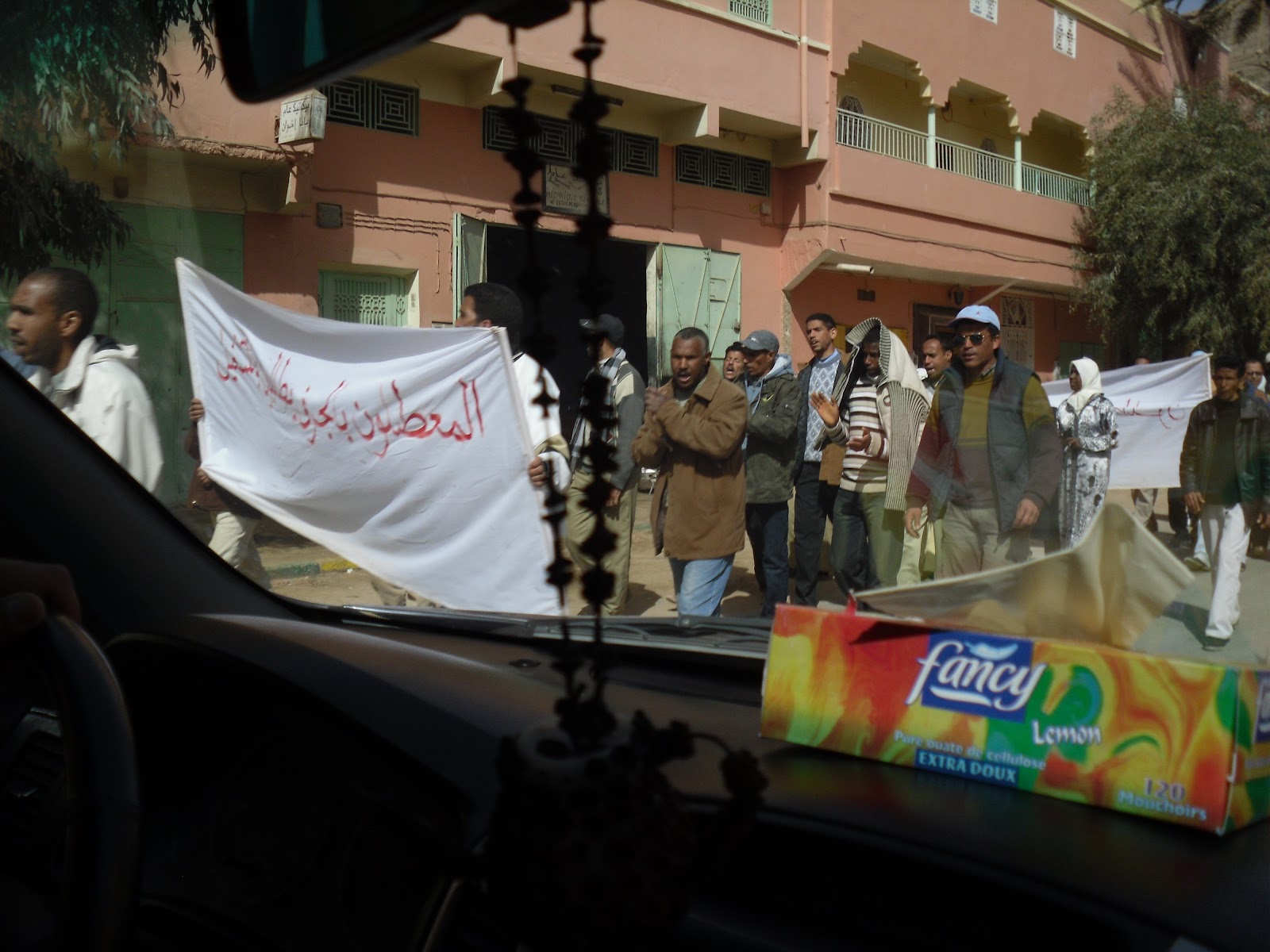
Jorf Village: After about two hours on the road, we pass our second demonstration of the trip.  The first was in the Middle Atlas on the first day.  A little smaller today, the issue remained the same: unemployment.

Tinerhir: Settled to the south of touristic Tordra Gorge, this picturesque village was bustling with kids going to / from school and construction workers preparing for the King's visit in the next couple of days.  The white paint around the bottom of the trees is an attempt at "area beautification."

Tinerhir: The lush valley fed by the Gorge.

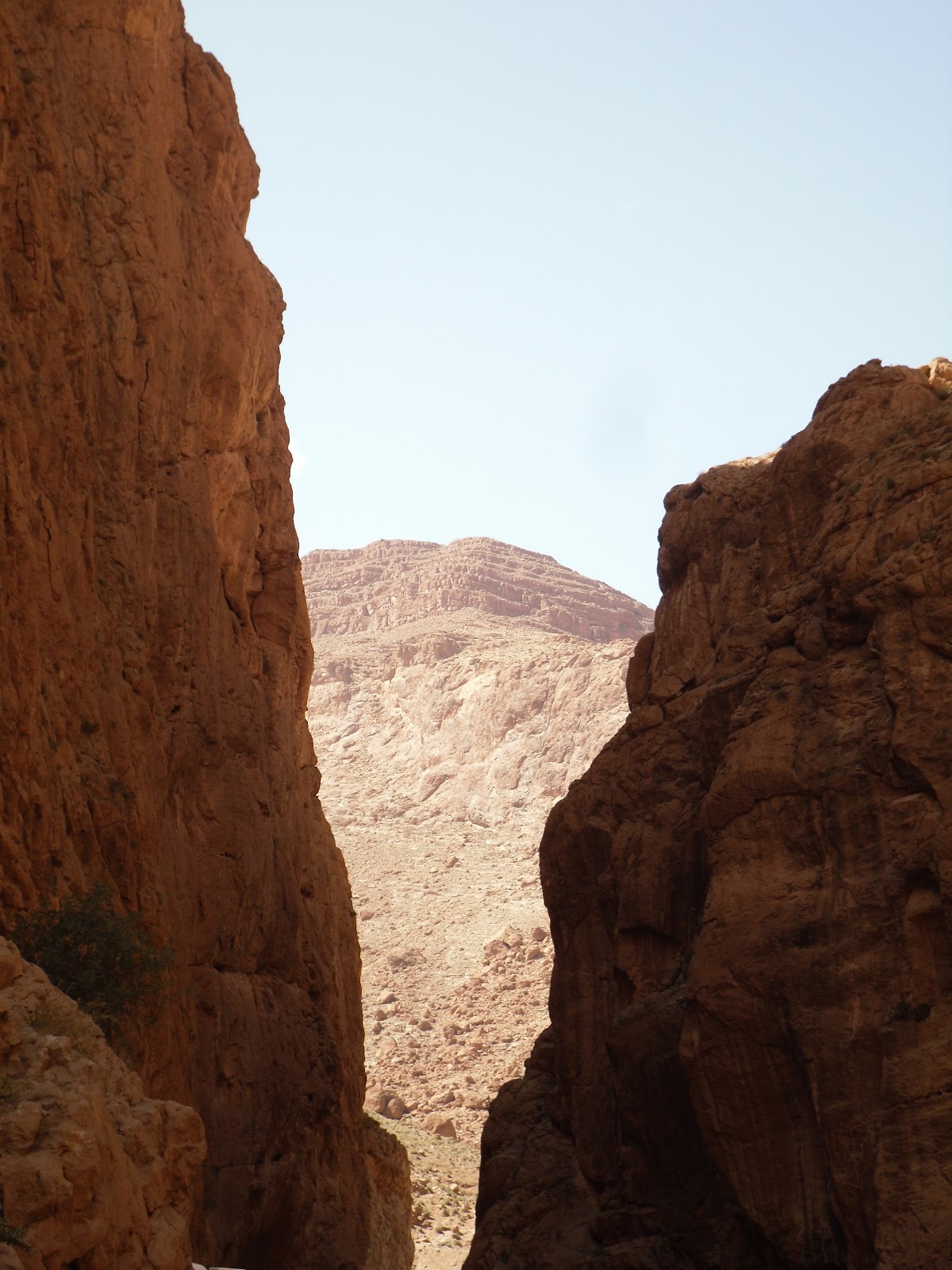
Todra Gorge: Windy, chilly and full of French, German and Japanese tourists


The Dades Valley: The village of Bouman du Dades overlooks one of the more lush valleys south of the High Atlas.

The Rose Valley: Named for the roses that are cultivated every May in the Rose Festival, this valley lies to the west of the Dades, is less fertile but produces more than its share of the country's rose and almond totals.

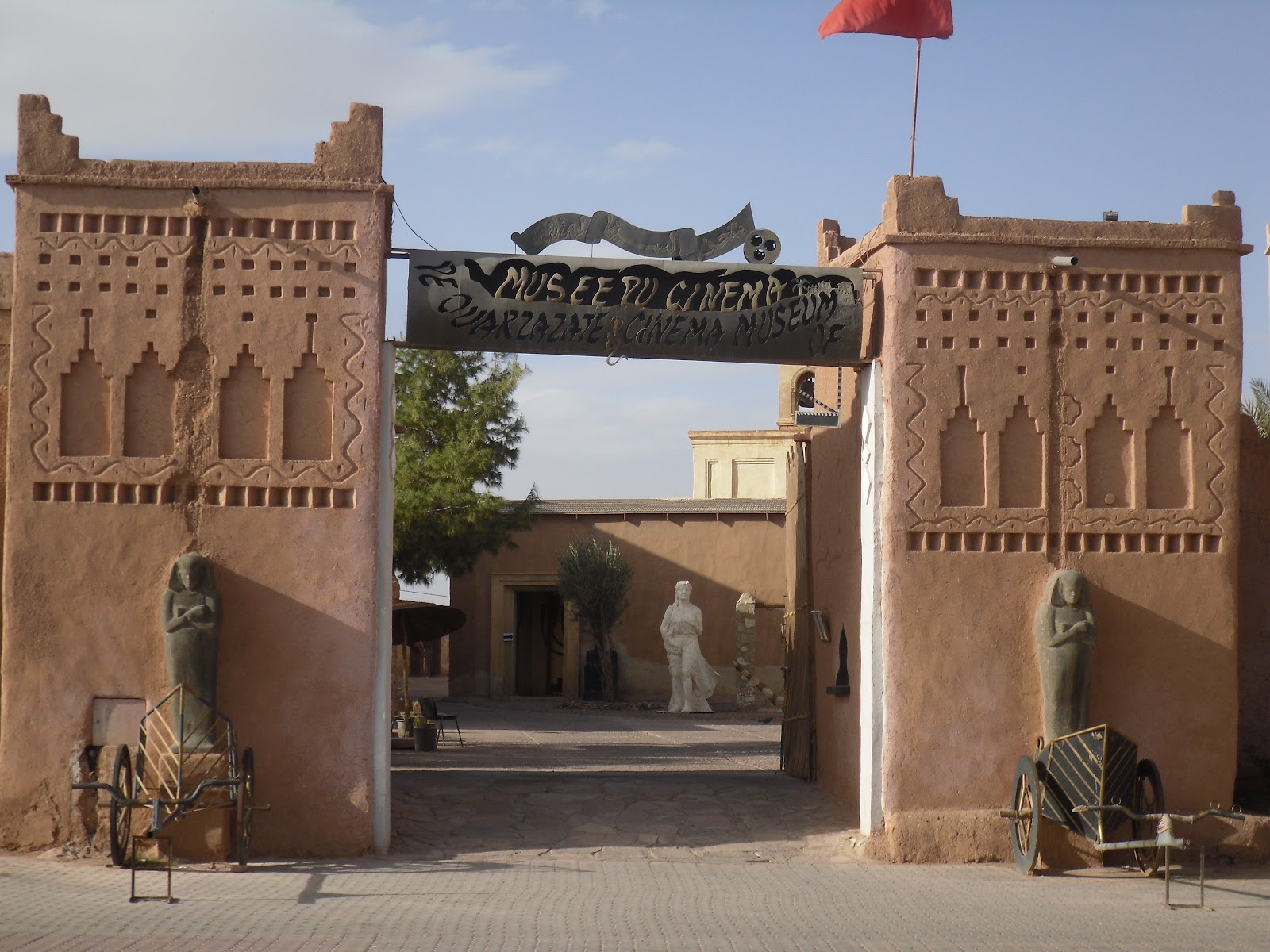
Ourzazate (war-za-zat): The country's ultra-modern film capital houses a cinema university, museum, two production companies and a kasbah used as a backdrop for Star Wars

Taourirt Kasbah: Used in Star Wars as well as other lesser-known Arabic and American Films.  

Ourzazate: Ramparts and Street Lights

Ouarzazate: Atlas (above) and Cla Cinema Productions

Ait Benhaddou: Another UNESCO World Heritage site, this 11th century kasbah has been renovated and re-used in the past century as a popular movie (and photo) backdrop.  Gladiator and Alexander (and Bessey) most recently...

The views to the north and south of the kasbah in Ait Benhaddou.  Again, a strategic location for Sultans centuries ago.

Tizi n' Tichka: Weaving through the High Atlas Mountains between Marrakesh and Ourzazate, this is the highest pass in the country at nearly 2500m (~7500').  Scenic doesn't describe the effects that the different layers of rock, vegetation and structures give viewers.  

One of my favorites.

This is the second shot that reminded me of Afghanistan in the pass, but the entire thing could play a suitable double for the country's northeastern provinces.

My second-favorite shot, stretching some 40 km to the furthest peak.

After 4 days, Zayed and I parted ways at the Marrakesh Train Station.  I'd recommend him and his company to anyone!

After four long days, I saw a lot and came away meeting most of my goals.  Wanting to see the majority of the population, they obliged my eyes with a couple demonstrations, streets lined with endless shops and always an opportunity to purchase something at every stop.

Unemployment (in our sense of the word) is bad in most of the villages, and it's easy to see it along their roads (even at highway speeds).  Both demonstrations demanded better employment opportunities and most people I ran into overtly wanted something from me.  It was refreshing, however, to see that the unemployed had the freedom to demonstrate.

Most of them spoke in Berber, lived in villages named after Berbers and flew Berber flags.  A majority in this country, their language doesn't enjoy "official" status.  Before today, I didn't see how much of an issue that is.

Saw some regional and national agricultural and resource centers for apples, dates, watermelons, honey, Kohl, fossils, roses and tourism.  The latter arguably being the most important of all of them in economical terms.

Probably most importantly, I was reminded that plans differ from execution and things aren't always as simple as they appear.  Looking at the map before my trip, I saw green fade to brown to yellow and back to green over lines and around dots.  Four days to see all of them: easy.  Not so, of course.  The lines and dots have meaning and complicate or sweeten the journey.

None of this was more prevalent than when we arrived to the dunes of Merzouga.  My first impression was, "This is it?"  Measuring ten by fifteen kilometers, we drove around them and I could visualize getting in them and easily following the sun to their other side on foot.  These were not the endless Saharan dunes that filled my head since childhood.

Getting inside of them though showed how difficult it was to actually make that "small" trip.  The temperature dropped and the sand gave way at every step, expanding each dune in both length and height.  At the risk of exaggeration, meters became miles.  Not helping was the wooden and burlap stirrup-less saddle cutting into my inner thighs.

Coming out of the desert the next day on one of the longest one-hour trips I've taken in recent memory provided a little more perspective and - again - my mind drifted to jobs past.  In this case, however, I couldn't help but wonder if our policy makers thought the same things I did the day before as they looked at their maps of Afghanistan and Iraq in 2002 and 2003.

Perhaps unlike Bush's Vulcans, I'd happily take my journey again though.