I've seen glimpses of the big cities; now it's time to get on the open road and take in the eastern and southern attractions of my host country. As per your requests, I'm off to the Sahara after spending an afternoon in Casablanca.
This trip is a four-day guided tour from Fes to Merzouga and back to Marrakech. The ultimate draw is Merzouga's reddish dunes, which are unique within Morocco. To Fes - and from Marrakech - it's travel by train but everything in between is a mix of SUV and Dromedary (camel).

Aside from seeing the sites and major attractions, my primary purpose is to see (and hopefully become familiar with) the majority of the population, as it still resides outside the big cities. Further, I hope to take enough away from this trip to be able to guide my own tours as visitors (any of you) make it to Morocco for a trip...
Day One was long (10 hours by train and SUV) and from my pilot's seat, I had ample opportunity to take notes as my guide and I talked, we zoomed by villages and mingled with locals. Below is a refined list of my notes for that day, edited as necessary...
Day 1: Rabat to Merzouga
- Wake at 5:00 AM, Train at 6:07, Arrive Fes at 8:45.

- Met with my guide, Zayed, at the Fes Station - young guy, been here since yesterday; there was a mix up regarding my arrival: they thought I was coming yesterday. I feel bad.
- Zayed, a Berber, teaches me a proverb of patience in how to deal with our 7-hour trek: نقطة بنقطة كيحمل الواد (Drop by drop, as the river is filled). Slowly but surely, we will arrive.
- There are four dialects of Berber. Three are similar to one another while the final one differs dramatically.
- In the Middle Atlas, we pass containers of all shapes, sizes, makes and colors on the side of the road, stacked on small piles of rocks. They contain honey, which can go for 300 MAD (~$3.50) per liter.
- The "moon rocks" north of Ifrane (my future home) remind me of the Goshta, Afghanistan, landscape.
- The largest cedar forrest in the country sits in the Middle Atlas between the villages of Ifrane and Azrou.
- The view of the Middle Atlas south of Ifrane is how I expected it (but didn't see during my last trip). Beautiful but damn cold.
- We pass by the most beautiful building I've seen so far north of Azrou. I'm told it's a UAE-built orphanage.
- We stop by the only location in the country where we might see the Barbary Apes. They don't show.
- Around the town of Timahdite, you farm, run a shop, herd sheep, belong to the 1% who are government employed or the remaining 50% who are unemployed.
- After asked, Zayed tells me Moroccans refer to police as "snakes," not "pigs" or "bacon."
- Generations ago, an old volcano spit up a ton of black lava rocks around Timahdite.
- Small wheat fields the size of American gardens litter an otherwise barren hillside between the Middle and High Atlas.
- Dogs of the village Itzer crowd the roads, waiting for lunchers from nearby Zeida to discard their scraps while heading north.
- Between the two Atlases, the terrain is generally flat, sprawling and barren. Ugh, four more hours until our destination.
- The village of Zeida, like the three previous villages, is a ghost town.
- God, Country, King. Written in white-painted rocks on most mountains, remind locals to keep their priorities straight.
- Passing a military outpost, Zayed tells me most of the Moroccan Army are in the east, along the mountains. I'm reminded of the Syrian border fort me and the boys occupied in 2003.
- To get into the Moroccan Army, I'm told a recruit needs "to pay for the privilege." I'm later told that most Soldiers later regret it because being a Soldier is a thankless job.
- The village of Midelt, population 35,000, is known as "The Big Apple." It's the country's apple capital.
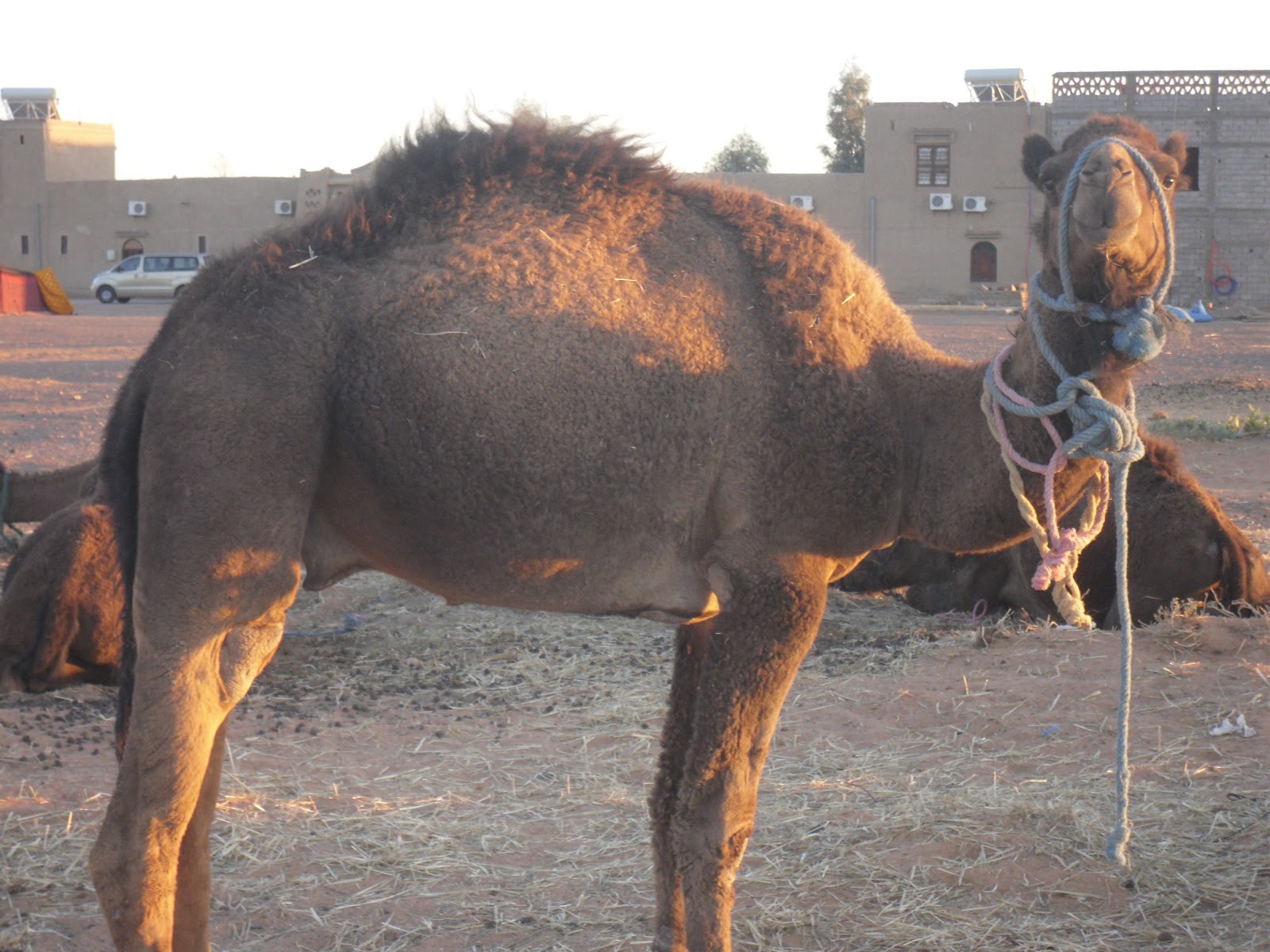
- No camels in Morocco; they have two humps. There are only Dromedaries with one hump.
- Shakira reportedly filmed a perfume commercial in Merzouga.
- Hillary Clinton also visited Merzouga because her family is from Morocco.
- Part of the movie "Legionnaire" was filmed in Merzouga.
"Legionnaire" Reviews (IMDb): Users: 4.9 stars / 10 stars (7,381 votes) 55 reviews | Critics: 22 reviews
- Driving in the village of Kerrandou, around 70 protesters (mostly kids) walk in the other lane carrying banners and chanting about how the government needs to provide them more jobs and educational opportunities.
- North of the Gorge du Ziz (big ravine of the Ziz valley), I'm told that in the summer it gets so hot (50 degrees Celsius) that the "humeer enfejroon" (the donkeys explode).
- The Gorge reminds me of the Grand Canyon, except not as grand. This reminds me of my family; I look forward to seeing them again.

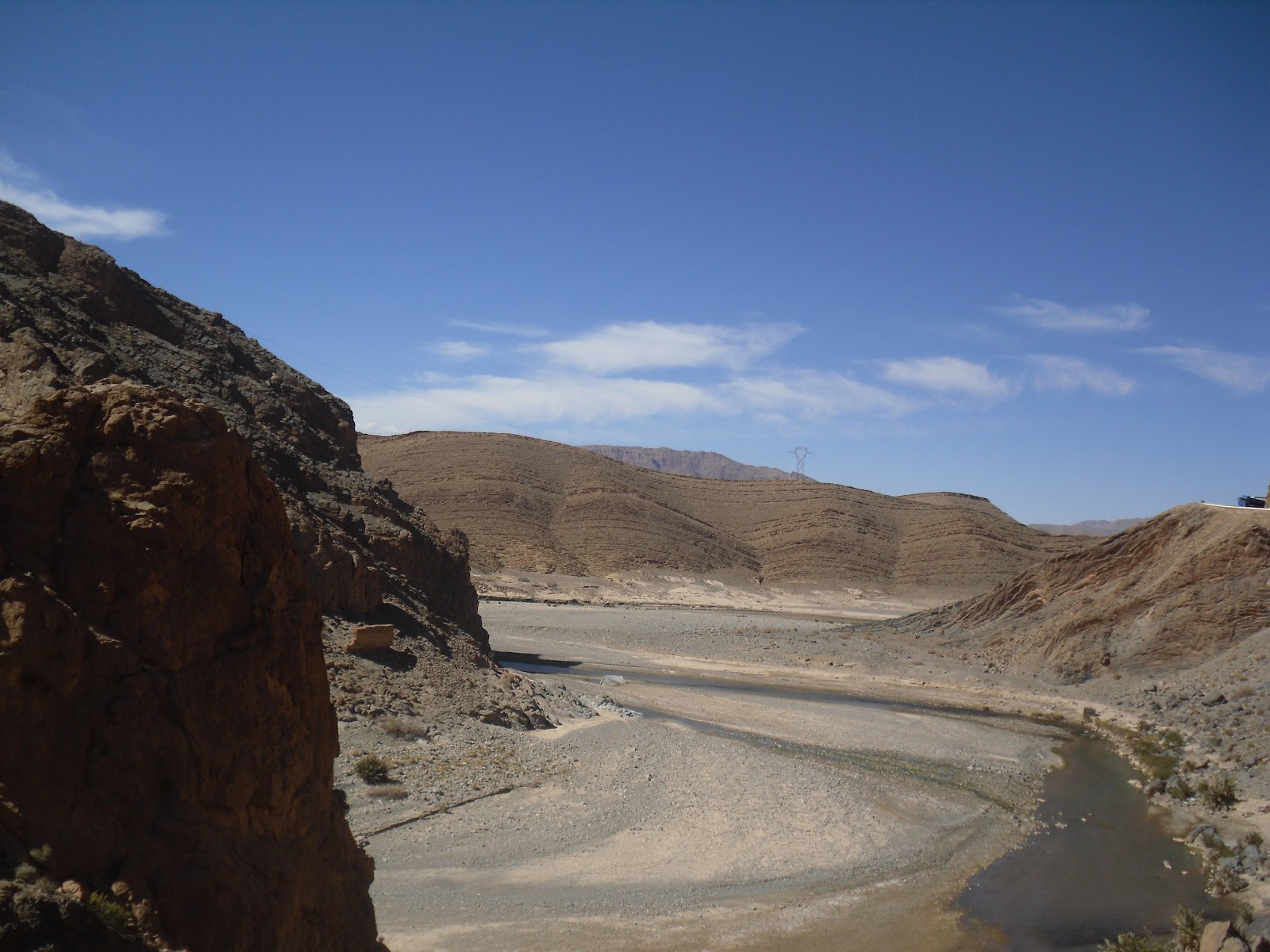
- Another military post. Two more hours until Merzouga (Thank God!).
- Somewhere on our way to Timbuktu, I'm informed that there are 37 "States" in Morocco and 80 "Provinces."
- The scenic overlook of the Ziz Valley is pretty impressive. I learn what I feel I should've known already: dates come from palm trees.

- The transical music that's been playing for the past two hours is from the Tuareg, a Berber tribe who moved from Morocco to Mali in te 1950's. Speaking of Mali, the expression "Going to Timbuktu" comes from this area, as it took the caravans of old about 52 days to travel from south-central Morocco to Timbuktu, Mali.
- We pass a Moroccan flag on a parked vehicle on the side of the road. I'm told that means either someone's getting married or returning from the Hajj.
- The last village on our way to Merzouga is Erfoud. Famous for dates and fossils, I couldn't care less because my butt hurts from seven hours of continual sitting.

Hard to see, but the writing on the ridge is an advertisement for all of the fossiles and minerals for sale in Erfoud
- Another example of environmental issues: out the passenger-side window sits an area roughly the size of 8 football fields littered with all kinds of plastic (bags, bottles, etc.) from a nearby wind-scattered burning pit.
- Shortly after the processed sea (and 45 kilometers west of Algeria), we finally spot the rosy dunes of Merzouga.

Tomorrow, I'll enter them.


love this post- thanks for taking us along for the ride!
ReplyDeleteIf dates grow on date palms and the "ship of the desert" is a dromedary (Camelus dromedarius), what are Dromedary dates???
ReplyDeleteHa, well played, Jan. I believe they're the kind that you try not to step in!
ReplyDeleteHmmm. When I was a kid, Dromedary dates were the brand my mom bought at the grocery store. I thought, then, all dates were dromedary dates. Walking in the footsteps of live dromedaries near Zagora, I had an "ah-ha" moment -- discovering, perhaps, the inspiration for the brand name.
ReplyDelete