Growing up, I didn't inherit a lot of my old man's interests. A quiet guy who preferred to spend his days off sitting in cool autumn breezes waiting for whitetail deer to pass his way, my dad spent countless hours most other days pursuing his father's professional dream of building a tool and die business. With one of my uncles, they started Bessey Tool & Die in 1988, and my dad's run the company since my grandfather's passing in 1996.
I'm described as many things, but "quiet" scarcely makes the list; hunting never took, and my choice of profession skewed from tool making. As a result, there haven't been a lot of opportunities to share with my dad one of the traits that I think I inherited from him: my ability to plan and put something together. Hopefully, he and the rest of my family enjoyed the two weeks I put together for them and don't need too much of a vacation from their vacation before they return to work on Tuesday!
If you ask me, the vacation ended in the north as well as it began in Rabat, with some pretty interesting moments in between. Starting in the country's capital made a lot of sense, allowing for some rest and jet-lag recovery while easing my guests into my current hometown and Muslim culture. Also, the city's calm nature might give them something to later compare Marrakesh's potential craziness.
The Rabat segment included a few familiar sites for followers of this blog. The main highlights again included Chellah, The Tour Hassan and La Oudaya. Complimenting them, drives past Parliament, the Royal Palace, National Library and Mohammed V University provided a glimpse of the current political and educational systems. However, the introduction to driving in this country may have made a larger impact on my guests than any of these sites, as my sister describes it:
After a much less terrifying drive (hopefully), our first stop was the ruins of Phoenician-found Chellah. Later occupied by the Romans in 40 AD and then the Merenids in the 14th century, most of what remains today is from the latter. Cats, storks and eels are today's inhabitants, so my animal-loving sister and mother enjoyed them almost as much as the blooming gardens.


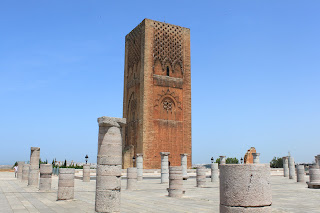
The Tour Hassan was our second stop. Built by the Almohads to resemble the Koutoubia minaret in Marrakesh, it was the site's prominent feature until the Mausoleum of Mohammed V was dedicated as the final resting place of the current monarchy's first king.

La Oudaya completed the first day's activities. Also built by the Almohads, this 12th century kasbah is home to the city's oldest mosque as well as a small part of its population. Adorned by a garden and offering a pleasant overlook of northern Sale, this area taught my mom and sister what happens when you're not assertive.

After a few hours, the initial exposure concluded and it was back to the apartment for some rest and preparation for the first - and biggest - trip of the vacation. Spanning five days and including the most diversity of any part of the visit, Marrakesh and the desert would test some limits. Until then, for more of Chellah, The Tour Hassan and La Oudaya, click here, and thanks, sis, for the comments!
Not to be dismissed but not finding a place in the overview, we now have "Our Hail of Bullets:"
Putting Together an Itinerary: After a handful of emails elliciting destinations, I quickly found that my family decided to take two weeks to see the country for good reason - they wanted to see it all: the desert, coast, mountains and big cities dominated their responses.
The four mini-trips that I later decided on quickly began to come together in my head. The first would stay in Rabat, be a low-key trip around the city's sites, allow for some jet-lag to pass and some acclimatization to occur. The southern trip to Marrakesh and the desert next came to mind because it would be the most difficult and diverse, giving my guests a Moroccan "slap in the face" that would shock the senses and test their still-fresh physical limits. Including the tourist city, a pass over Morocco's highest road as well as the desert, this trip would span a handful of days amidst diverse ethnic lines.
Requiring at least a day of rest afterward - and a shorter trip, I looked to Fes and the Middle Atlas for the second destination. Here, the focus would be on historical Morocco and its cultural and religious center. Further, the difference between Fes and Marrakesh would be highlighted, as the former's more laid-back environment and medina would contrast the latter's hectic pace and nightlife. A stop to the country's most preserved Roman ruins would also expose another aspect of the country's history, while a visit to my future university would give them a glimpse into my future.
After another day of rest, the trip would conclude in the north, with stops to "The International City" of Tangier, one of Spain's African hamlets, Sebta, and the old Spanish protectorate's capital in Tetouan. Later, a stop to Moulay Boussalham's bird sanctuary would be added to appease the nature - and boat - lovers' exposure to one of the country's overlooked sanctuaries. The visit nearly went as planned, minus the stop in Tetouan, which was cut due to a lack of time and desire to get back to Rabat and pack for the next day's early flight.
I'm described as many things, but "quiet" scarcely makes the list; hunting never took, and my choice of profession skewed from tool making. As a result, there haven't been a lot of opportunities to share with my dad one of the traits that I think I inherited from him: my ability to plan and put something together. Hopefully, he and the rest of my family enjoyed the two weeks I put together for them and don't need too much of a vacation from their vacation before they return to work on Tuesday!
If you ask me, the vacation ended in the north as well as it began in Rabat, with some pretty interesting moments in between. Starting in the country's capital made a lot of sense, allowing for some rest and jet-lag recovery while easing my guests into my current hometown and Muslim culture. Also, the city's calm nature might give them something to later compare Marrakesh's potential craziness.
The Rabat segment included a few familiar sites for followers of this blog. The main highlights again included Chellah, The Tour Hassan and La Oudaya. Complimenting them, drives past Parliament, the Royal Palace, National Library and Mohammed V University provided a glimpse of the current political and educational systems. However, the introduction to driving in this country may have made a larger impact on my guests than any of these sites, as my sister describes it:
Being it our initial exposure to Morocco (aside from the altogether frightening drive with Dad from the airport)...I'm still surprised that we didn't A) knock a parent/child pair off a bike, or B) get crushed on both sides attempting those dastardly turn arounds.
After a much less terrifying drive (hopefully), our first stop was the ruins of Phoenician-found Chellah. Later occupied by the Romans in 40 AD and then the Merenids in the 14th century, most of what remains today is from the latter. Cats, storks and eels are today's inhabitants, so my animal-loving sister and mother enjoyed them almost as much as the blooming gardens.

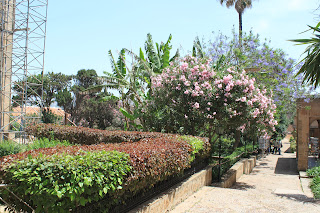
Throughout Rabat, Marrakesh, Fes and Agadir, a different type of "purple haze" lines the streets.

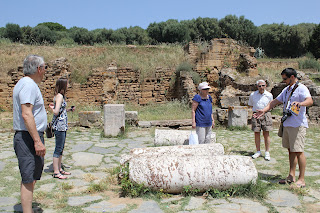
On the Roman side, a few words from the unofficial guide.

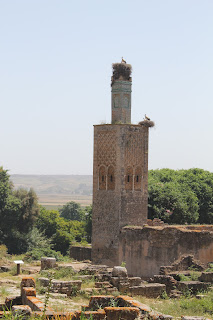
The Merenid Minaret. As my Sister, Megan, put it, "To my pleasure, Chellah, the Mausoleum, and the Tombs were right up my alley! Old, historic, and not too hectic, they were a smooth introduction to the vacation. Not too much to say here that you haven't said about the sights in the past - they were very cool and filled with sleepy stray cats!

One of the few remaining Roman artifacts not moved to the Archeological Museum.

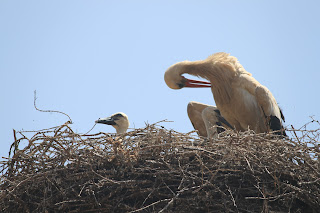
Baby storks huddled in most nests in each of the large cities.

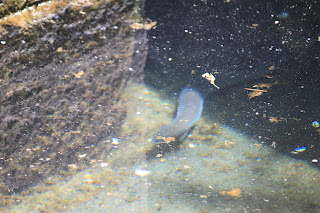
The myth is that if women want to bear child, they should feed eggs to the resident eels. No one from our group must have been interested, as the one eel we saw wasn't biting on any of the dozen eggs it was fed.
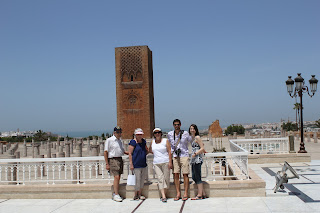
The Tour Hassan was our second stop. Built by the Almohads to resemble the Koutoubia minaret in Marrakesh, it was the site's prominent feature until the Mausoleum of Mohammed V was dedicated as the final resting place of the current monarchy's first king.

The minaret dominates the city's skyline as well as the country's Tomb of the Unknown Soldier resting at its base.

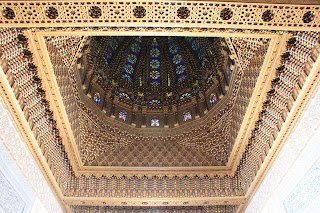
The Mausoleum's Ceiling: A Tremendous Display of Ornamentation.

On one side, Guards post in white; on the other, the horses and their mounts are adorned in brown.

The Beginning of Father's Photography.

The Sun was in full effect, requiring a stop at the "Local Drinking Fountain."
La Oudaya completed the first day's activities. Also built by the Almohads, this 12th century kasbah is home to the city's oldest mosque as well as a small part of its population. Adorned by a garden and offering a pleasant overlook of northern Sale, this area taught my mom and sister what happens when you're not assertive.

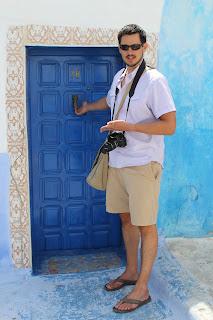
The Hand of Fatima adorns most entrances along the blue-painted alleys to ward off the Evil Eye.

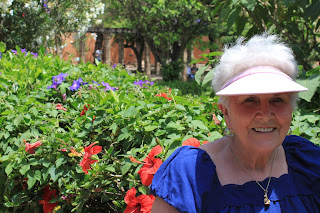
Grandma Rose in front of some Garden Flowers.

Spring in Bloom.

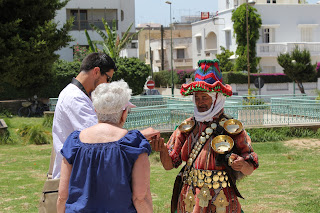
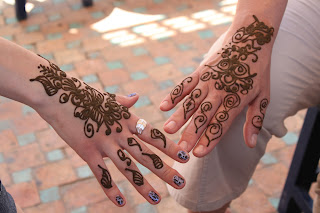
"I didn't buy anything!" was the first thing my mom quipped to my dad as she and my sister were corralled to him by a couple of young henna artists who reportedly, "told us that they just wanted to see our beautiful hands," and then started stenciling artwork before anything drastic such as walking away could be done. Welcome to Moroccan bargaining! Megan adds: "I'd rather not get into the whole 'henna' debacle - but let me just say for the record that I'm way too nice to live in a country like Morocco!"

One of the tranquilly-pleasing Oudayan Alleys. Megan agrees, "Oudaya was beautiful as well - the blue and white walls felt very appropriate for a town so close to the beach. It was interesting to see a town so different from what I'm used to in the USA, with the tight winding paths through the buildings (though it wouldn't be the first that we saw of that!)."
Not to be dismissed but not finding a place in the overview, we now have "Our Hail of Bullets:"
- Home-cooked food has been missed, as I was reminded by sloppy joe's, egg and bacon breakfasts and brats.
- The tramway's open in Rabat! After months of delays and undoubtedly years of planning and construction, the new public transportation not only looks good but also increases the time to travel along it by car tenfold.
- The Jazz Festival in Rabat is huge, playing in at least four alternate sites over the weekend.
- Rabat's main attractions (Chellah, the Tour Hassan and La'Oudaya) are not that interesting the fourth time around (as you may agree!).
- After my father's recent vehicular accident, navigating our vehicle in Morocco nearly gave him a heart attack, but he did great.
- No protests or demonstrations were witnessed, but a trash strike cluttered a couple alley ways toward the end of the trip.
Putting Together an Itinerary: After a handful of emails elliciting destinations, I quickly found that my family decided to take two weeks to see the country for good reason - they wanted to see it all: the desert, coast, mountains and big cities dominated their responses.
The four mini-trips that I later decided on quickly began to come together in my head. The first would stay in Rabat, be a low-key trip around the city's sites, allow for some jet-lag to pass and some acclimatization to occur. The southern trip to Marrakesh and the desert next came to mind because it would be the most difficult and diverse, giving my guests a Moroccan "slap in the face" that would shock the senses and test their still-fresh physical limits. Including the tourist city, a pass over Morocco's highest road as well as the desert, this trip would span a handful of days amidst diverse ethnic lines.
Requiring at least a day of rest afterward - and a shorter trip, I looked to Fes and the Middle Atlas for the second destination. Here, the focus would be on historical Morocco and its cultural and religious center. Further, the difference between Fes and Marrakesh would be highlighted, as the former's more laid-back environment and medina would contrast the latter's hectic pace and nightlife. A stop to the country's most preserved Roman ruins would also expose another aspect of the country's history, while a visit to my future university would give them a glimpse into my future.
After another day of rest, the trip would conclude in the north, with stops to "The International City" of Tangier, one of Spain's African hamlets, Sebta, and the old Spanish protectorate's capital in Tetouan. Later, a stop to Moulay Boussalham's bird sanctuary would be added to appease the nature - and boat - lovers' exposure to one of the country's overlooked sanctuaries. The visit nearly went as planned, minus the stop in Tetouan, which was cut due to a lack of time and desire to get back to Rabat and pack for the next day's early flight.


No comments:
Post a Comment