Given the results of my last poll, our next stop on the Moroccan tour is in the Meknes area. I got on the highway this morning and spent a good, drizzly day out at the ruins and the city of Moulay Idriss before returning to Rabat in the early evening. Great trip - click here to get an idea of the route!
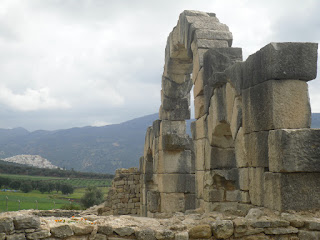
The Roman ruins of Volubilis sit in the midst of a fertile plain about 33km north of Meknes. The city is the best preserved archaeological site in Morocco and was declared a UNESCO World Heritage site in 1997. Its main attractions are the large preserved mosaics somehow remaining in the floors of some of the ruined structures.


Originally settled by the Carthaginians in the 3rd century B.C., Volubilis was one of Rome's most remote outposts until its annexation in 40 A.D. An agricultural center for wheat and olives, the city housed 20,000 people at its peak.

Some of the most impressive remains (the Triumpheral Arch, Capitol and Balsica) were established between the 2nd and 3rd centuries before the Romans abandoned it in 280 A.D. The city was inhabited by Berbers, Greeks, Jews and Syrians until the 18th century when the city was plundered and later destroyed by the Lisbon earthquake in 1755.*
More than 30 structures are marked today with little site descriptions. Most of them are named after the mosaics or ruins found within them rather than for some religious or historical reason. Names are both common (House of Dogs, House of Half Pillars, House of the Knight) and regal (House of the Labours of Hercules, House of Venus, Temple of Saturn), but all remains resemble each other today.


After the trip to Volubilis, I stopped by the holy town of Moulay Idriss a few kilometers away. Sitting atop two hills, the city is named after the founder of Morocco's first real dynasty. A great-grandson of the Prophet Mohammed, Moulay Idriss fled Saudi Arabia to Morocco in the 8th century.



After a weekend in the desert, the Middle Atlas' lush, rolling plains, overcast skies and light drizzle was a welcome change of pace. Another example of the country's diversity, Volubilis and Moulay Idriss also can claim to be the first locations where I noticed Moroccans partaking in the tourism outside of the role of guide or transport.
(*thank you to "Lonely Planet: Morocco" for providing most of the Volubilis description)
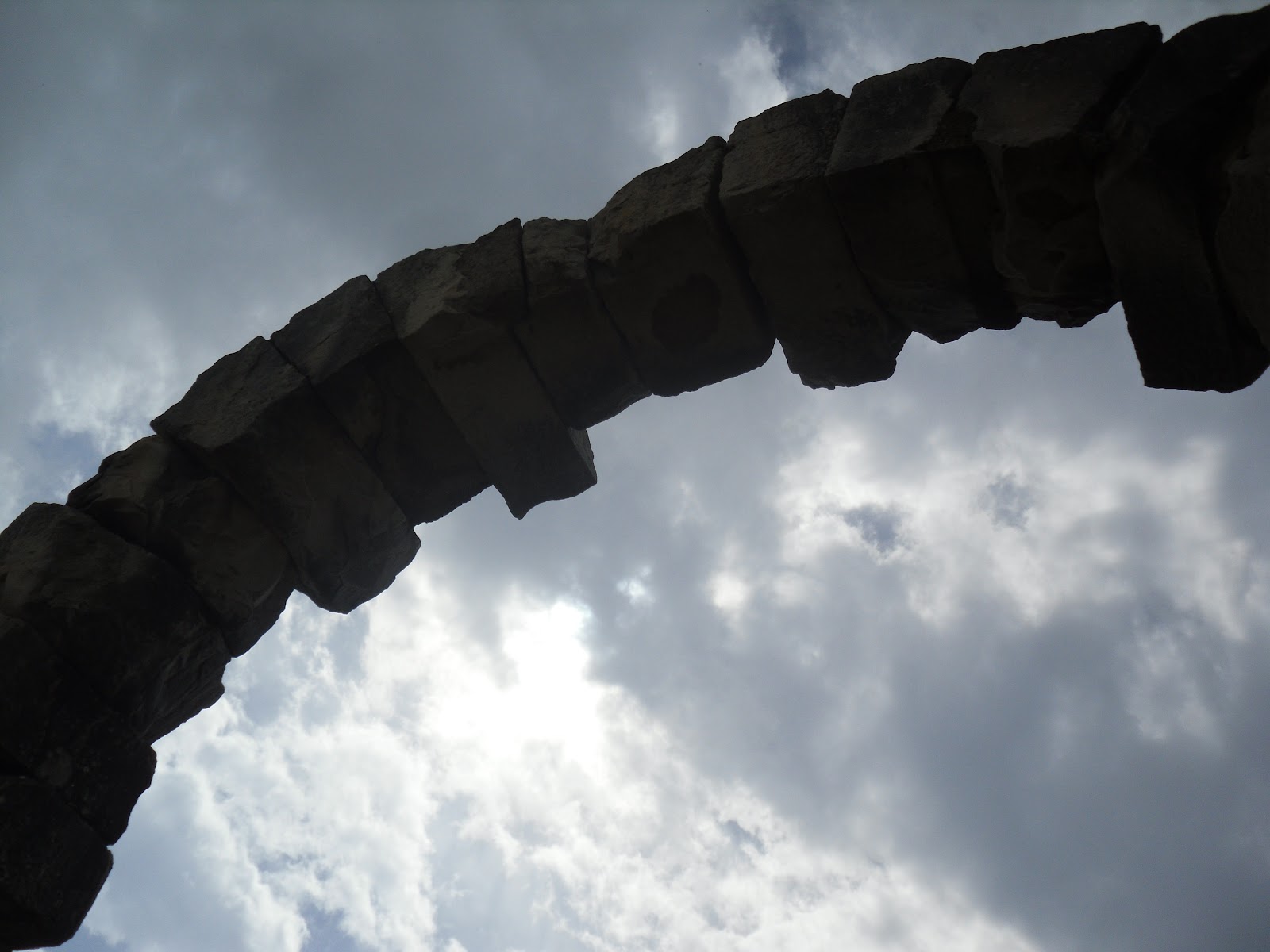
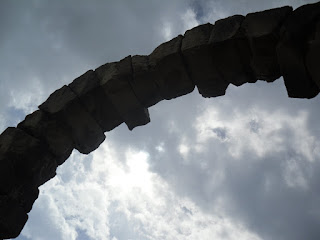
A stone arch at Volubilis. No supports that I could see - just balanced rocks. How'd they build that?

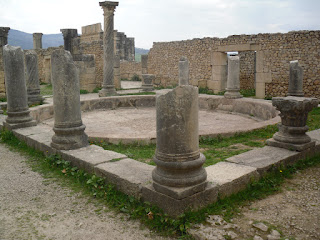
The Balsica, built between the 2nd and 3rd centuries

One of the handful of alleys

The House of Columns

Taken on the trip to the site, an example of those rolling plains in the Middle Atlas
Some of the most impressive remains (the Triumpheral Arch, Capitol and Balsica) were established between the 2nd and 3rd centuries before the Romans abandoned it in 280 A.D. The city was inhabited by Berbers, Greeks, Jews and Syrians until the 18th century when the city was plundered and later destroyed by the Lisbon earthquake in 1755.*

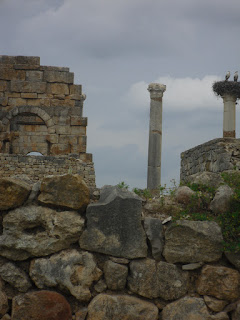
Storks nesting above the Forum and Balsica. Chellah was more populated though.

House of Venus

House of Venus

House of Venus

House of the Dionysus & the Four Seasons
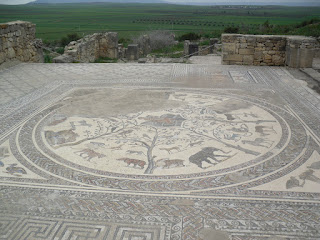
Covering over 40 hectres (about 99 acres) Volubulis contains a mix of remains. Its mosaics were the most impressive part of the site though. The level of detail and size of each of them was most impressive given the period in which they were made. On average, thousands of .5" x .5" tiles covered about 16 square meters to create each mosaic.

House of Labours of Hercules

House of the Acrobat (riding his donkey backwards)
A fair amount of the mosaics were looted or moved to museums elsewhere so, given man's tendency to "take the best and leave the rest," what a picture this place must have been at its height.

Galen's Baths

From Volubilis' western gates, Moulay Idriss sits in the distance
He settled Volubilis, converted the population to Islam and continued to expand his influence, later moving his capital to nearby Meknes. Today, he's buried in Moulay Idriss and still provides good reason to visit.

The Moulay Idriss Mausoleum "limit of advance" for non-Muslims. For Moroccans, 5 pilgrimages to the yearly festival here is considered an appropriate substitute for a "Hajj" trip to Mecca (which is more than most of the devout population can afford, even once in a lifetime).

One of the white-washed building entrances between the Mausoleum and the terraces. Much like Chefchaouen's powder blue.

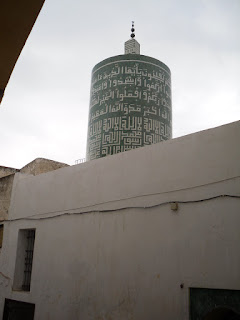
The Green Minaret, reportedly Morocco's only spherically-shaped minaret, the words "la illah ila Allah" (There is no god but God) and other surrahs of the Quran are written around it.

Moulay Idriss' white-washed walls from the petite terrace. The green-roofed buildings are part of the city's grand mosque. Green is the traditional color of Islam and adorns most religious sites' roofs.
(*thank you to "Lonely Planet: Morocco" for providing most of the Volubilis description)


How very cool! I've seen the mosaics in Ravenna, Italy, but these are amazing. It does make you wonder how it looked in its heyday.
ReplyDeleteYou're not kidding! The book as well as a couple of the guides there mentioned that a large number (no one said for sure how many) were moved or stolen. I assume those that were removed were just as detailed or more so. It was surprising also to see how well-preserved the site is given its age as well as the freedom of visitors to roam around and pretty much touch what they want.
ReplyDelete